They Never Saw 9/11: America’s New Generation and the Rebranding of Terrorism as “Resistance”
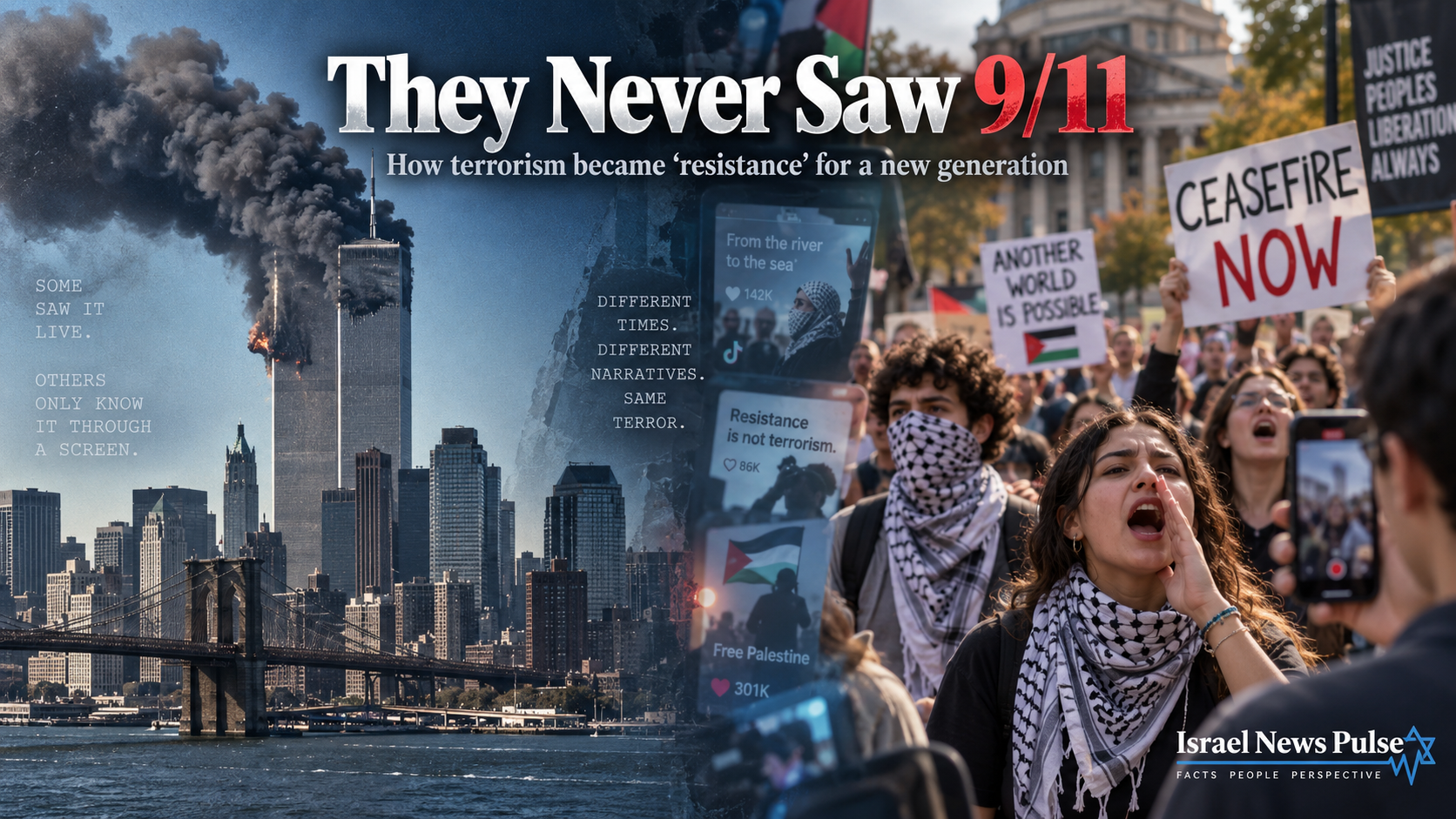
For millions of Americans, September 11 is not history.
They remember watching the second plane hit the World Trade Center. They remember people trapped above the flames, the Pentagon burning, the towers collapsing and Manhattan disappearing beneath smoke.
They remember discovering, in real time, what a small group of Islamist extremists willing to die for an ideology could do to an open society.
But an enormous part of America remembers none of it.
Roughly 30 percent of Americans were born after September 11, 2001. Every traditional high school student in America today was born after 9/11, as was virtually every traditional age undergraduate.
Among Americans aged 18 to 24, 60 percent told Pew Research Center that they first learned about 9/11 through school or classwork.
For them, September 11 is something they were taught.
For older Americans, it is something they lived.
9/11 Was Islamist Terrorism, Not an Abstract Political Argument
On September 11, 2001, 19 al Qaeda terrorists hijacked four passenger aircraft.
Two were deliberately flown into the World Trade Center. Another struck the Pentagon. Passengers fought back aboard Flight 93 before it crashed in Pennsylvania.
The attacks killed 2,977 people.
Osama bin Laden and al Qaeda combined political grievances against the United States with a radical Islamist worldview and the concept of violent jihad. American foreign policy was not merely something to criticize. It was presented as justification for religiously sanctioned warfare against Americans.
The result was not a university debate about colonialism, Western power or oppression.
It was passenger aircraft turned into weapons and thousands of civilians murdered in a single morning.
That experience shaped an American generation.
The generation now entering universities and the workforce was shaped by something very different.
The Generational Divide Is Real
Younger Americans today place substantially less emphasis on terrorism than older Americans.
Pew found that protecting the United States from terrorist attacks remains one of the leading foreign policy priorities among Americans 30 and older, while it ranks considerably lower among adults under 30.
There is also a substantial age divide over Israel and the Palestinians.
In a 2026 Pew survey, 32 percent of Americans aged 18 to 29 viewed Israelis favorably, compared with 68 percent of those 65 and older. Among Americans under 30, 58 percent viewed Palestinians favorably.
Hamas remains deeply unpopular, including among young Americans. Only 13 percent of those aged 18 to 29 viewed Hamas favorably.
So this is not a story about an entire generation becoming pro Hamas.
The more interesting change is how parts of that generation have learned to describe groups such as Hamas and the violence they commit.
When Terrorism Becomes “Resistance”
Immediately after the October 7 Hamas attack, National Students for Justice in Palestine circulated a “Day of Resistance Toolkit” for campuses across the United States and Canada.
It described the assault as an operation by “the resistance in Gaza,” called for support for “our resistance in Palestine” and placed the attack within a Palestinian “national liberation struggle.”
This was after Hamas terrorists crossed into southern Israel, murdered civilians and took hostages.
Yet the framework presented to students was not primarily Islamist extremism.
It was anti colonial resistance.
Similar language appeared elsewhere.
Columbia University professor Joseph Massad wrote about a Palestinian “resistance offensive,” using celebratory language to describe elements of what occurred.
Across protests and activist movements, terms such as “resistance,” “liberation,” “decolonization” and “freedom fighters” became part of the language surrounding a terrorist organization that had just carried out the largest massacre of Jews since the Holocaust.
Language matters because it determines the moral framework through which violence is understood.
If Hamas is first introduced as “the resistance,” Israel as “the colonizer,” and the conflict as one between an oppressor and an oppressed population, Hamas's own ideology can almost disappear.
Hamas Is Not Simply a Secular Liberation Movement
Hamas did not emerge from a secular Palestinian civil rights movement.
The U.S. State Department describes Hamas as an outgrowth of the Palestinian branch of the Muslim Brotherhood.
Hamas's original 1988 covenant was even clearer.
Article Two identified Hamas as one of the wings of the Muslim Brotherhood in Palestine. Its charter repeatedly invoked jihad. Article Eight declared: “Jihad is its path.”
The United States has designated Hamas as a Foreign Terrorist Organization since 1997.
Hamas is not identical to al Qaeda. The organizations have different histories, structures and strategies.
But both emerged from Islamist ideological traditions in which religion, politics and armed struggle are intertwined.
Describing Hamas exclusively as indigenous “resistance” therefore removes one of the central facts about the organization: its Islamist identity is not an accusation invented by Israel. It comes directly from Hamas's own history and founding documents.
The Muslim Brotherhood, Hamas and CAIR
The history of the Council on American Islamic Relations, or CAIR, also deserves attention, although it requires precision.
CAIR has never been convicted of supporting Hamas. It has never been charged with a terrorism offense, and no court has ruled that CAIR is a Hamas front.
But there is a documented historical record connecting CAIR's founders to organizations within the Muslim Brotherhood's Palestine network in the United States.
Evidence introduced during the federal Holy Land Foundation prosecution documented a network known as the Muslim Brotherhood's Palestine Committee, which was involved in efforts supporting Hamas.
CAIR founders Nihad Awad and Omar Ahmad previously held senior positions with the Islamic Association for Palestine. An internal Palestine Committee memorandum from 1994, later introduced as evidence in federal court, identified CAIR alongside other organizations within that network.
The U.S. government subsequently placed CAIR on an unindicted co conspirator list during the Holy Land Foundation prosecution.
A federal judge later wrote that the government had produced “ample evidence” establishing associations involving CAIR and organizations connected to the case. The same judge also ruled that the government's public release of the unindicted co conspirator list violated the due process rights of the organizations named.
CAIR itself was never prosecuted.
The FBI nevertheless restricted non investigative engagement with CAIR beginning in 2008, citing evidence from the Holy Land Foundation trial that officials said linked CAIR leaders historically to Hamas.
The Holy Land Foundation itself was convicted. Five of its leaders were also convicted in a case involving millions of dollars sent through organizations prosecutors said supported Hamas.
The point is not that CAIR and Hamas are the same organization.
They are not.
The point is that documented historical connections between CAIR's founders, Muslim Brotherhood affiliated networks and organizations involved in supporting Hamas exist in federal records. They should neither be exaggerated nor erased.
CAIR and the Language of October 7th & 9/11
CAIR condemned the September 11 attacks on the day they occurred, describing them as “vicious and cowardly acts of terrorism against innocent civilians.”
So there is no factual basis for claiming CAIR told Americans that America deserved 9/11.
CAIR New Jersey’s 9/11 curriculum for American classrooms recently presented the terror attacks through a heavy focus on Islamophobia, U.S. foreign policy and the treatment of Muslims after September 11.
The lesson describes the hijackers merely as “a group self identifying as AlQaeda,” links their attack to American support for Israel, the Gulf War and the U.S. military presence in the Middle East, yet never explicitly identifies the perpetrators as Islamist terrorists.
A curriculum supposedly teaching children about 9/11 should be able to confront the ideology behind the terrorists who murdered nearly 3,000 people instead of blaming "Islamophobia" and Jews.
Its rhetoric after October 7, however, has been far more complicated.
At an American Muslims for Palestine convention in November 2023, CAIR executive director Nihad Awad said he was “happy to see people breaking the siege” on October 7 and argued that Palestinians had a right to defend themselves while Israel did not.
Awad later said his remarks had been taken out of context and stressed that civilians must never be targeted.
Several CAIR regional officials nevertheless used language including “decolonization,” “uprising,” “resistance” and “freedom fighters” in the immediate aftermath of October 7.
That language overlaps directly with the ideological vocabulary circulating through parts of the American campus movement.
The Strange Alliance Between Islamism and the Radical Left
Hamas and the radical progressive left begin from very different ideologies.
Hamas is Islamist.
The radical left is overwhelmingly secular and often interprets conflicts through colonialism, racial politics and a division between oppressor and oppressed.
Yet those frameworks can converge.
Hamas becomes “resistance.”
Israel becomes the colonizer.
Violence becomes “decolonization.”
The actual religious ideology of Hamas becomes secondary, or disappears altogether.
For a generation that never experienced 9/11, this framing arrives in a very different environment.
Young Americans grew up with the Iraq and Afghanistan wars rather than the shock that produced them. They consume far more political information through social media. And they have spent years consuming propaganda, activist messaging and selectively framed accounts of wars across the Middle East, often with little explanation of the Islamist organizations participating in those conflicts.
What Happens When 9/11 Becomes History?
No major study has yet measured exactly how much the loss of personal memory of September 11 contributes to these changing attitudes.
That does not make the question irrelevant.
It makes it unanswered.
One generation experienced Islamist terrorism directly.
Another generation encounters September 11 primarily through textbooks, documentaries, social media and political interpretation.
At the same time, that younger generation is being introduced to modern Islamist terrorist organizations through a political vocabulary that can transform jihadists into “resistance fighters” and terrorism into “liberation.”
These developments may have multiple causes. Social media, ideology, education, political polarization and propaganda all matter.
But none of them excludes the possibility that something important was lost when September 11 stopped being a memory and became a history lesson.
Twenty five years after the attacks, America is entering a new era.
Millions of Americans now know what Islamist terrorism can do only because someone told them.
And that raises a question worth taking seriously:
As the lived memory of September 11 disappears, has it become easier to repackage Islamist terrorism for a new generation as “resistance” and “liberation”?