
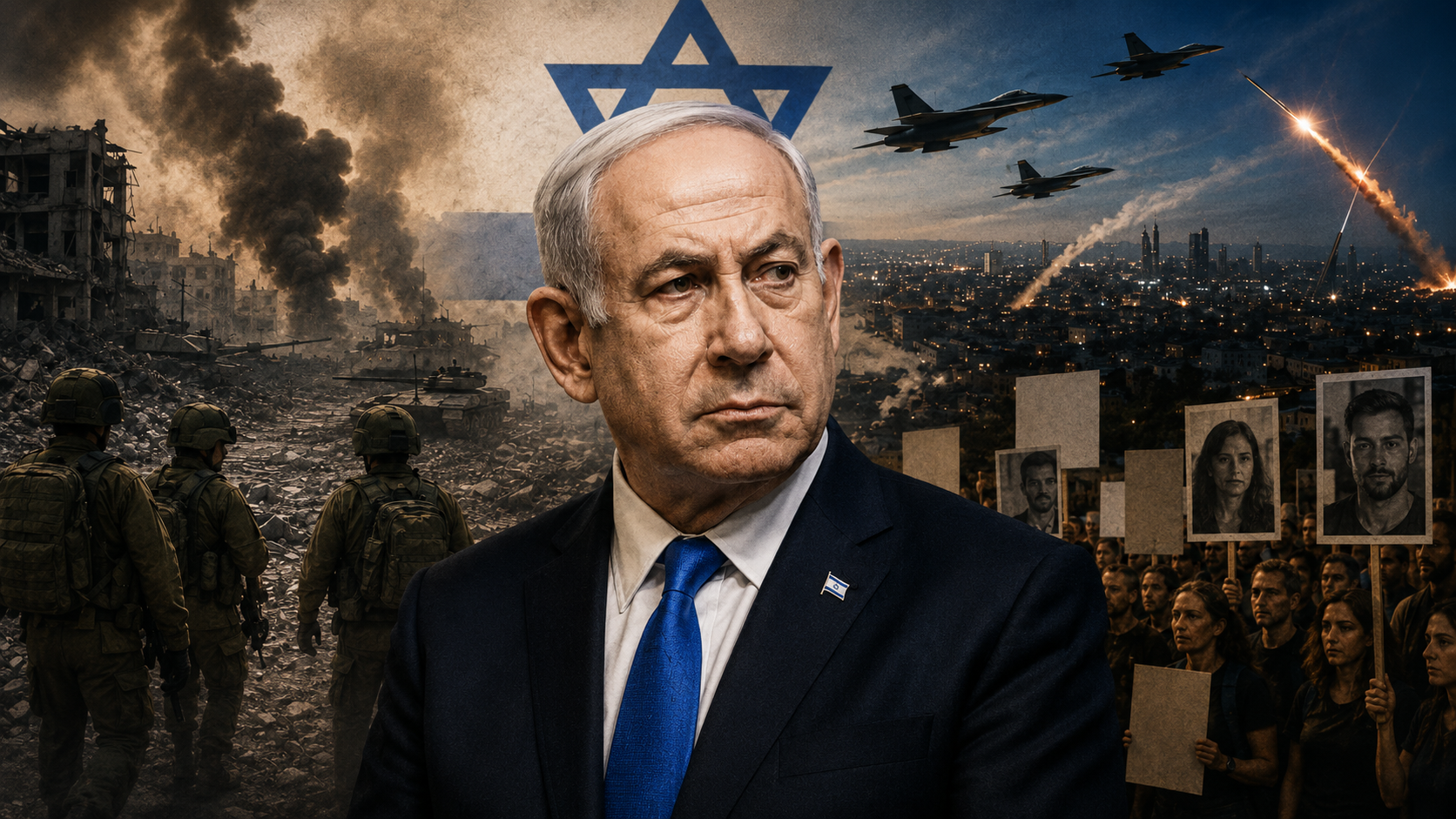
Nearly three years after the October 7 attack, Israel has inflicted extraordinary damage on several of its most dangerous enemies.
Hamas lost much of its organized military structure. Hezbollah’s senior command was devastated. Israeli forces demonstrated an unprecedented ability to strike deep inside Iran. Most Israelis evacuated from the north eventually returned home. Nearly all of the hostages were ultimately brought back alive or their remains recovered.
Benjamin Netanyahu was prime minister throughout these events.
So did he lead Israel well?
The evidence points to a more complicated answer than either his supporters or critics usually offer.
Netanyahu can reasonably claim credit for several major strategic decisions that produced significant military gains. But those achievements sit alongside serious failures in preparedness, hostage policy, postwar planning and political accountability.
The fairest verdict, based on the evidence available through August 23, 2026, is that Netanyahu’s wartime record is genuinely mixed and still unfinished.
Israel’s military performance was often impressive
Any assessment that ignores Israel’s battlefield achievements would be incomplete.
Hamas entered the war with an organized force built around five regional brigades, 24 battalions and roughly 30,000 to 35,000 fighters, according to Israeli and independent assessments cited during the war.
By 2025, the IDF said that formal structure had largely been dismantled and Hamas had been reduced primarily to guerrilla warfare.
Israel also destroyed much of Hamas’s rocket capability. One Israeli military assessment put the destruction of its rocket arsenal at roughly 90%.
The organization’s losses were enormous.
But Hamas was not eliminated.
By July 2026, Israeli security assessments reported by Kan estimated that Hamas still had around 25,000 Qassam Brigades fighters, including approximately 2,500 Nukhba operatives. Many were newly recruited and far less capable than the fighters Hamas had before the war, but the manpower itself had substantially regenerated.
The tunnel network proved even harder to destroy. Estimates cited by former National Security Council chief Giora Eiland and other security sources suggested that a large portion of it remained intact.
That makes Netanyahu’s original objective of destroying Hamas’s military capabilities difficult to describe as fully achieved.
A more defensible conclusion is that Hamas was severely degraded, but not destroyed.
Netanyahu deserves some credit, but not for every military success
This distinction matters.
Netanyahu was the political leader who authorized major campaigns and made decisions about when Israel would escalate.
Those decisions matter.
But killing Yahya Sinwar was an IDF operation. The campaign that eliminated Hassan Nasrallah and much of Hezbollah’s senior leadership depended heavily on Israel’s military and intelligence services. Operations deep inside Iran relied on years of intelligence preparation, Air Force capabilities and, in later stages, extensive American military involvement.
A prime minister should receive credit for authorizing successful strategy.
He should not automatically receive personal credit for every successful Mossad operation, airstrike or battlefield decision carried out while he was in office.
Israeli public opinion itself has reflected this distinction.
Polling during the wars repeatedly showed Israelis approving some major military decisions while expressing significantly less confidence in Netanyahu personally.
That is an important clue to understanding his record.
The northern front may be Netanyahu’s strongest result
The war with Hezbollah produced one of the clearest measurable improvements in Israeli security.
Tens of thousands of Israelis were forced from their homes after Hezbollah began attacking northern Israel on October 8, 2023.
The displacement lasted for months.
By February 2025, only about a quarter of northern evacuees tracked in one major study had returned.
Later, the situation changed dramatically.
By September 2025, the government’s Tnufa North administration reported that approximately 55,000 of 64,200 evacuees, around 87%, had returned.
Kiryat Shmona remained below its pre-war population, but most evacuated northern communities were again populated.
That followed devastating blows against Hezbollah.
Nasrallah was killed. Much of the group’s senior command was eliminated. Its infrastructure near Israel’s border was badly damaged. Lebanon’s military subsequently began implementing a disarmament process south of the Litani River.
For residents who spent more than a year unable to live safely in their own homes, that is not an abstract achievement.
It is significant.
But here too, there is an important qualification.
Hezbollah survived.
Reuters later reported that the organization was rebuilding rockets and drones with Iranian assistance, while Israeli officials complained that Hezbollah was rearming faster than Lebanon was disarming it.
Fighting again intensified during 2026.
So the northern campaign looks like a major tactical and operational success, but whether Netanyahu converted it into a durable strategic victory remains unresolved.
October 7 remains the largest mark against Netanyahu’s record
Any evaluation of Netanyahu as a wartime leader has to begin before Israel’s response to October 7.
It has to begin with October 7 itself.
The IDF’s own investigations concluded that the military failed in its mission to protect Israeli civilians and was unprepared for the scale of Hamas’s assault.
Military Intelligence had received information about Hamas’s plans but fundamentally misunderstood the organization.
Hamas was treated as deterred.
The Shin Bet also accepted responsibility for its own failures.
But its internal investigation went further.
It identified broader policies that helped Hamas build strength, including the Israeli policy of maintaining prolonged periods of quiet, the flow of Qatari money into Gaza, erosion of Israeli deterrence and increasing dependence on defensive measures rather than offensive action.
Those findings do not absolve the IDF or Shin Bet.
They do, however, make it difficult to argue that October 7 was purely an intelligence failure with no political dimension.
Netanyahu had been Israel’s dominant political figure for most of the period during which the policy of containing Hamas developed.
Israel’s State Comptroller later faulted Netanyahu for never establishing a formal national security strategy, describing that absence as a serious problem in the years preceding the attack.
At the same time, the existing IDF investigations deliberately did not examine the political leadership.
That is crucial.
Israel still lacks the kind of independent State Commission of Inquiry that could authoritatively determine how responsibility should be divided between Netanyahu, previous governments, the military and the intelligence services.
That means sweeping claims that Netanyahu alone “caused October 7” go beyond the established evidence.
But so does any attempt to separate him entirely from the strategic assumptions that preceded it.
The hostage record is both an achievement and one of the biggest controversies
The hostages were eventually returned.
That matters enormously.
Netanyahu’s government ultimately approved agreements in January and October 2025 despite fierce opposition from some of his own coalition partners.
Ben-Gvir later publicly acknowledged that his political faction had repeatedly used its influence to prevent a hostage agreement from advancing.
Smotrich also openly opposed deals he believed would end the war without defeating Hamas.
The fact that Netanyahu eventually approved agreements despite that pressure cuts against the simplest version of the accusation that his coalition partners completely controlled his decisions.
But there is another side.
A major dispute centers on negotiations during 2024.
Reporting based on negotiation documents indicated that Netanyahu introduced additional conditions in July 2024 involving issues including the Philadelphi Corridor and movement of Palestinians back into northern Gaza.
Gallant, then-IDF chief Herzi Halevi and other security figures reportedly warned that the conditions could derail negotiations.
Netanyahu strongly denied that he had introduced fundamentally new demands and argued that Hamas was responsible for blocking an agreement.
There is evidence supporting parts of both accounts.
Former Biden Middle East adviser Brett McGurk, one of the American officials most deeply involved in the negotiations, later argued that Hamas repeatedly refused commitments necessary to finalize agreements and sought to remain in power after the war.
The strongest responsible conclusion is therefore narrower than many political claims.
There is substantial evidence that Netanyahu hardened Israel’s negotiating position at critical moments. There is also substantial evidence that Hamas repeatedly obstructed agreements.
What has not been proven is the most explosive accusation: that Netanyahu deliberately kept hostages in captivity primarily to preserve his coalition.
That remains an allegation, not an established fact.
The lack of a Gaza endgame hurt Israel
One of the strongest criticisms of Netanyahu does not concern how Israel fought Hamas.
It concerns what was supposed to happen after the fighting.
Senior Israeli security officials repeatedly warned that destroying Hamas units without creating an alternative governing structure would allow the organization to return.
Halevi reportedly described the IDF’s task as “Sisyphean” without a replacement for Hamas rule.
Gallant publicly accused the government of failing to formulate a viable postwar plan.
Former Military Intelligence chief Tamir Hayman similarly argued that victory required not only military pressure but also an alternative administration in Gaza.
The problem became increasingly visible as Hamas rebuilt parts of its civilian control and recruited new fighters.
This is one area where political responsibility is easier to assign.
The IDF can destroy a battalion.
It cannot decide who governs Gaza afterward.
That is a political decision.
And nearly three years after October 7, Hamas’s continued ability to exercise civilian influence in Gaza represents one of the clearest examples of Israel struggling to translate military victories into lasting strategic outcomes.
Iran may eventually define Netanyahu’s legacy
Netanyahu spent decades warning that Iran represented Israel’s greatest strategic threat.
Eventually, he acted.
Israel’s direct attacks on Iran produced major military results. Iranian commanders were killed, air-defense networks were penetrated, missile infrastructure was hit and Israeli aircraft demonstrated an extraordinary ability to operate deep inside Iranian territory.
These were not simply operational decisions made by field commanders.
The decision to launch such campaigns was political and strategic.
Netanyahu therefore deserves considerably more direct credit for choosing to confront Iran than he does for individual tactical operations in Gaza or Lebanon.
But the Iran story is not finished.
As of August 23, 2026, the broader conflict remained unresolved.
Iran retained the capacity to rebuild parts of its military infrastructure. Questions remained about the long-term state of its nuclear program, missile production and regional proxy network.
If the Iran campaigns ultimately produce years of significantly improved Israeli security, historians may judge Netanyahu’s decision as one of the defining strategic successes of his premiership.
If they lead instead to prolonged warfare followed by Iranian military reconstruction, the judgment could look very different.
It is simply too early to know.
Netanyahu’s accountability record is much harder to defend
There is another test of wartime leadership that has nothing to do with missiles or fighter jets.
Accountability.
Senior Israeli security officials accepted personal or institutional responsibility for October 7.
Herzi Halevi resigned as IDF chief of staff, writing that responsibility for the failure would accompany him for the rest of his life.
Shin Bet director Ronen Bar similarly acknowledged his agency’s failure.
Netanyahu has not offered an equivalent acceptance of personal responsibility.
More importantly, nearly three years after the attack, Israel still had not established a traditional independent State Commission of Inquiry examining both the security and political leadership.
Netanyahu has supported alternative forms of investigation, arguing that an inquiry must be balanced.
His critics argue that only an independent state commission can credibly investigate decisions made by the prime minister and his government.
Regardless of political affiliation, the absence of such an inquiry leaves a serious hole in Israel’s understanding of the worst security disaster in its history.
On accountability specifically, Netanyahu’s record is difficult to characterize as successful.
The economy survived, but the cost was enormous
Israel’s economy proved much more resilient than many feared.
Growth resumed, exports recovered and Bank of Israel forecasts pointed to strong expansion if security conditions stabilized.
That is significant after years of reserve mobilization, evacuations and military spending.
But resilience should not be confused with absence of cost.
Bank of Israel estimates put the fiscal cost of the wars at roughly NIS 350 billion before including all costs associated with later fighting.
The economy also lost substantial potential output.
Businesses suffered from reserve mobilization, tourism collapsed during major periods of fighting and communities along Israel’s borders endured enormous disruption.
Some of these costs were unavoidable consequences of fighting wars Israel did not choose to begin.
Others depend on whether the wars lasted longer than necessary, a question still fiercely disputed.
The economic record therefore does not provide a simple argument either for or against Netanyahu.
Israel absorbed an extraordinary financial shock without economic collapse, but it paid heavily to do so.
So, did Netanyahu do a good job?
There is no intellectually serious way to reduce the record to either “Netanyahu saved Israel” or “Netanyahu failed at everything.”
Israel under Netanyahu recovered from the catastrophe of October 7 and inflicted extraordinary damage on Hamas, Hezbollah and Iran.
The northern border became substantially safer for many residents.
The hostages eventually returned.
Israel demonstrated military and intelligence capabilities that surprised both its enemies and much of the world.
Netanyahu deserves credit for some of the political decisions that made those outcomes possible, particularly decisions involving major escalation against Hezbollah and Iran.
But military accomplishments do not erase what came before or what remained afterward.
October 7 occurred after years in which Israel badly misunderstood Hamas.
Netanyahu has not accepted personal responsibility comparable to that accepted by senior security officials.
An independent State Commission of Inquiry still has not established the political chain of responsibility.
Hamas was degraded but not destroyed.
Its rule in Gaza was not fully replaced.
Hezbollah was badly weakened but began rebuilding.
The hostage negotiations included serious and still unresolved accusations that political and strategic considerations delayed agreements.
And Israel repeatedly struggled to convert spectacular tactical victories into final political arrangements.
That leads to a more useful conclusion than simply declaring Netanyahu either a successful or failed wartime prime minister.
He proved far more successful at authorizing and sustaining military campaigns than at preventing the original catastrophe, ending wars cleanly, establishing postwar political arrangements or accepting accountability for failures.
That is a mixed record.
And because several of the conflicts and their consequences are still unfolding, it is not yet the final one.

