Looting, Fires and Attacks on Residents: Riot Scenes From France and Italy
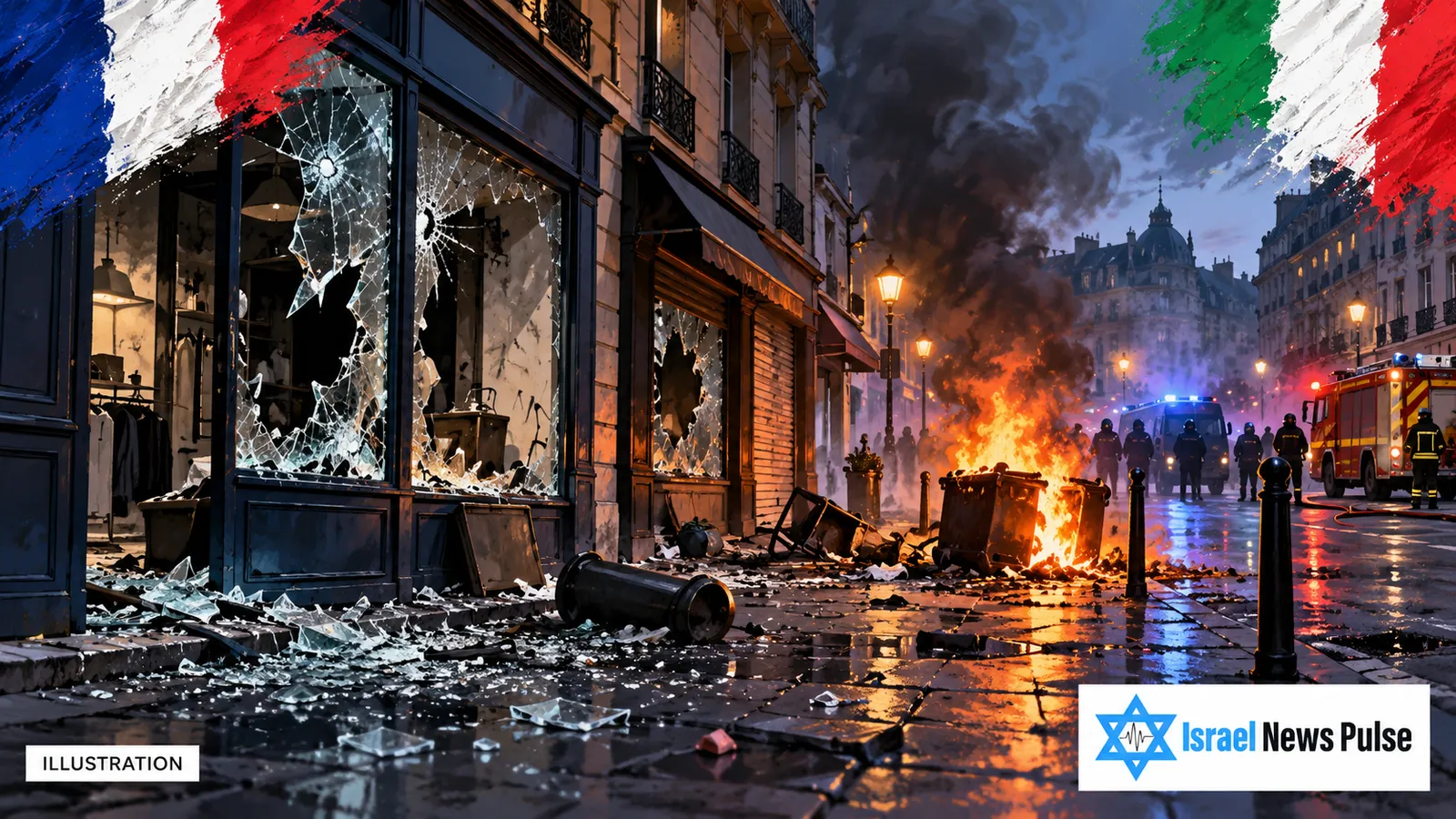
Shops are looted, emergency workers come under attack and residents confront people threatening their property. Israel News Pulse’s video compilation brings together scenes from France and Italy, tracing the violence through shopping streets, residential neighborhoods and confrontations with police.
The damage extends beyond broken windows. In Nice, a shopkeeper becomes a target after his business is ransacked. In Douai, friends gathered for a birthday face attackers armed with hammers. Elsewhere, firefighters trying to extinguish fires are attacked themselves.
Shopkeepers face the crowds
Outside a video game and cartoon shop in Nice, the owner confronts the destruction of his business. He is attacked from behind and pelted with objects while young rioters laugh.
His encounter exposes the danger facing anyone who tries to interrupt the looting. Protecting a shop can mean stepping directly into the path of the people destroying it.
In Saint-Denis, looters target a Snipes sneaker store. In the Belleville neighborhood of Paris, a Darty electronics shop is ransacked. At a DealBike store, a bicycle is taken amid shouts of “Wallah.”
Different businesses, different merchandise, the same immediate consequence: owners left to account for stolen stock and damaged premises.
At a Zara shop, the destruction is accompanied by a political message. “Free Palestine” is written on the windows after the store is ransacked.
Elsewhere, a woman takes up position outside her business holding a large stick. She stands at the entrance, trying to prevent looters from getting inside.
A birthday gathering comes under attack
In Douai, northern France, the confrontation reaches a property rented by friends for a birthday celebration.
The accompanying account describes attackers trying to force their way inside, smashing cars and assaulting people with hammers. Those at the property try to protect themselves and their surroundings as the violence unfolds.
The gathering was private. The threat arrived at its door.
Other residents also intervene when destruction reaches their streets. A passerby confronts a person damaging a bus shelter and stops him with a slap.
Such encounters carry their own danger. A person trying to protect a business, a vehicle or public property can quickly become the next target.
Police and firefighters are attacked
From a rooftop in Paris, a person throws stones toward police vehicles and passersby below. The attack places people in the street at risk from above, beyond the immediate confrontations at ground level.
Another sequence concerns a man identified in the accompanying account as a plainclothes police officer, beaten after rioters discover his identity.
Firefighters also face violence while trying to put out fires. Attacking crews working to contain a blaze threatens both the responders and the surrounding property they are trying to protect.
Elsewhere, police confront people at the entrance to a ransacked shop. The compilation moves between officers responding to attacks and attempts to stop looting already underway.
Destruction becomes something to record
Some participants turn their actions into material for their own cameras.
Near the Champs-Élysées, a group poses for a photograph following looting, with members making offensive gestures. In another scene, a person films himself aboard a tourist road train described as hijacked.
The recordings preserve moments of celebration alongside the destruction.
They also capture danger to participants themselves. One person’s trousers catch fire. Another falls during looting. The extent of any injuries cannot be determined from the accompanying descriptions.
In Lyon, bricks taken from a nearby construction site are used to build a wall at the entrance to City Hall. Materials intended for building work become an obstruction outside a public institution.
By morning, the crowds have left parts of Paris with damaged storefronts and debris. What took moments to smash remains for someone else to clear, repair and replace.
The compilation extends to Italy
The Italian scenes center on Milan, where a gathering organized through social media is followed by smashed shop windows and looting at stores and supermarkets.
The accompanying accounts also describe unrest in Turin and Bologna and a public order meeting called by Prime Minister Giorgia Meloni.
These incidents have their own local circumstances. Placed alongside the French footage, they broaden the compilation’s account of violence reaching businesses, police and public spaces.
For those affected, the consequences are measured in practical terms: whether a shop can reopen, whether a damaged car can be used, whether emergency crews can reach a fire safely, and whether residents can remain secure inside a property.
The recording ends. The repairs, losses and unanswered calls for help remain.