U.S. Destroys Iranian Oil Tanker, Disables Two More After IRGC Targets Navy Warships
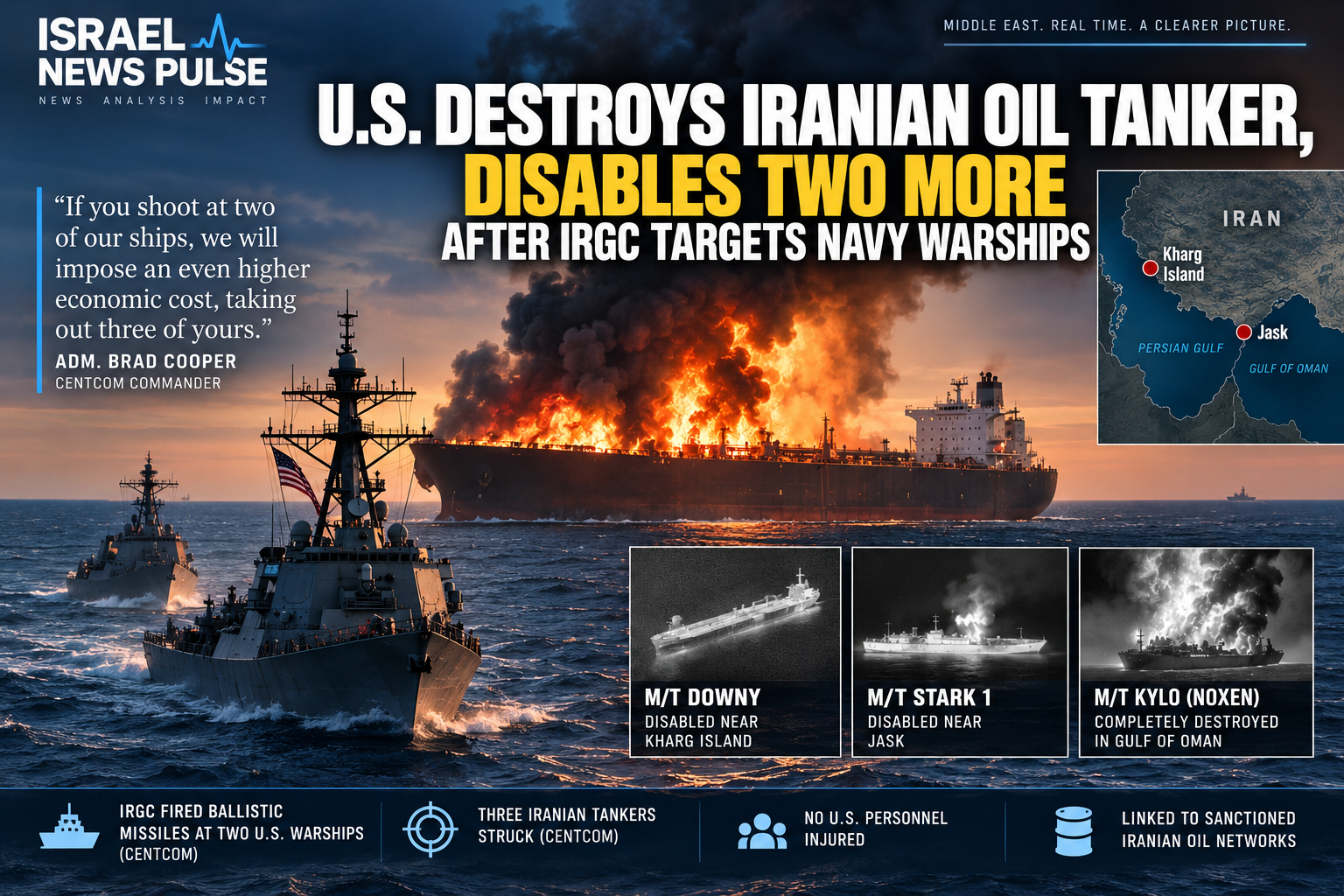
U.S. forces struck three Iranian crude oil tankers on Saturday after the IRGC fired ballistic missiles toward two U.S. Navy warships, according to U.S. Central Command.
One tanker was completely destroyed and two others were permanently disabled.
CENTCOM commander Adm. Brad Cooper made the message to Tehran unusually explicit.
"If you shoot at two of our ships, we will impose an even higher economic cost, taking out three of yours," Cooper said.
Iran targeted two U.S. warships, CENTCOM says
CENTCOM said the IRGC launched ballistic missiles toward an American aircraft carrier and a guided missile destroyer patrolling regional waters.
Both ships "successfully evaded" the attacks and no American personnel were harmed, according to the command.
CENTCOM did not identify either warship or disclose how many missiles were launched.
It also did not say the missiles were intercepted or shot down. It specifically said the ships "evaded" the attacks.
Reuters and AP reported the missile attack based on CENTCOM's statement. Iran had not publicly confirmed it at the time of writing.
Three Iranian tankers hit
CENTCOM said it responded by targeting three Iranian crude oil carriers.
The M/T Downy was struck off Kharg Island, Iran's most important crude oil export hub, while the M/T Stark 1 was struck near Jask. CENTCOM said both were permanently disabled.
The third tanker was hit harder.
CENTCOM said American forces "completely destroyed" the unladen M/T Kylo, also known as the Noxen, in the Gulf of Oman after its crew was directed to abandon ship.
The command released video of the strikes.
CENTCOM did not say the Kylo sank.
Iran reports a different picture near Kharg
Iranian media confirmed attacks on tankers but offered a different account of the strike near Kharg Island.
Iranian state broadcaster IRIB reported that four U.S. missiles struck a tanker roughly 10 kilometers from the island and said the crew was evacuated without casualties.
A Fars correspondent on Kharg reported hearing explosions but seeing no smoke. Iranpress later said the tanker's cooling system extinguished a fire in its early stages.
That differs from CENTCOM's description of the Downy as permanently disabled.
The actual extent of the damage near Kharg therefore remains unclear.
Why these tankers?
CENTCOM said the three vessels were part of a multibillion dollar shadow oil network funding the IRGC and its regional proxies.
U.S. sanctions records provide significant evidence connecting the ships to sanctioned Iranian oil networks.
The Downy and Stark 1 are linked to the National Iranian Tanker Company, which the U.S. Treasury designated in 2020 for supporting the IRGC Quds Force.
The Kylo has a particularly notable sanctions history.
U.S. Treasury records identify the vessel as part of the shipping network associated with Mohammad Hossein Shamkhani. Washington says that network has moved Iranian and Russian petroleum around the world through an opaque web of vessels and companies.
The sanctions records establish significant connections between these ships and sanctioned Iranian oil networks. They do not establish where the revenue from every individual voyage ultimately went.
Kharg Island is the heart of Iran's oil exports
The location of the Downy strike is significant.
Kharg Island has historically handled around 90 percent of Iran's crude exports.
Those exports have already been hit hard by the conflict and the U.S. blockade. Kpler data cited by The National showed exports from Kharg falling from roughly 1.98 million barrels per day in February to about 135,000 barrels per day in August.
Removing three tankers will not by itself cripple Iranian oil exports.
But every tanker destroyed or disabled reduces the fleet Tehran can use to move and store crude while operating under sanctions.
The important change is why America attacked
This was not the first time U.S. forces attacked Iranian tankers in 2026.
American forces have previously disabled vessels while enforcing Washington's blockade.
Saturday was different.
CENTCOM explicitly presented these strikes as retaliation for an attack on American warships.
And this time, one tanker was not simply disabled. CENTCOM says it was completely destroyed.
Cooper followed that with an even broader warning.
"We will not hesitate to defend American forces, and if necessary, destroy Iran's limited and exposed oil fleet."
That is the bigger story.
Washington is signaling that if Iran attacks American naval forces, the response may not be limited to Iranian missiles, launchers or military installations.
Iran's oil fleet itself can be used to impose an economic price.
What we still do not know
Several important details have not been disclosed.
CENTCOM has not identified the two American warships, said how many Iranian missiles were launched, identified the missile type, or explained exactly how the vessels evaded them.
The extent of the damage near Kharg also remains disputed between the American and Iranian accounts.
And while U.S. sanctions records connect all three tankers to sanctioned Iranian oil networks, they do not independently establish CENTCOM's specific assertion about how revenue from these particular vessels was used.
But Washington's message is not ambiguous.
CENTCOM says Iran targeted two American warships.
The United States responded by taking three Iranian oil tankers out of service.
Three tankers for two warships.