A Reminder: Why Exactly Iran’s Islamic Regime Must Fall
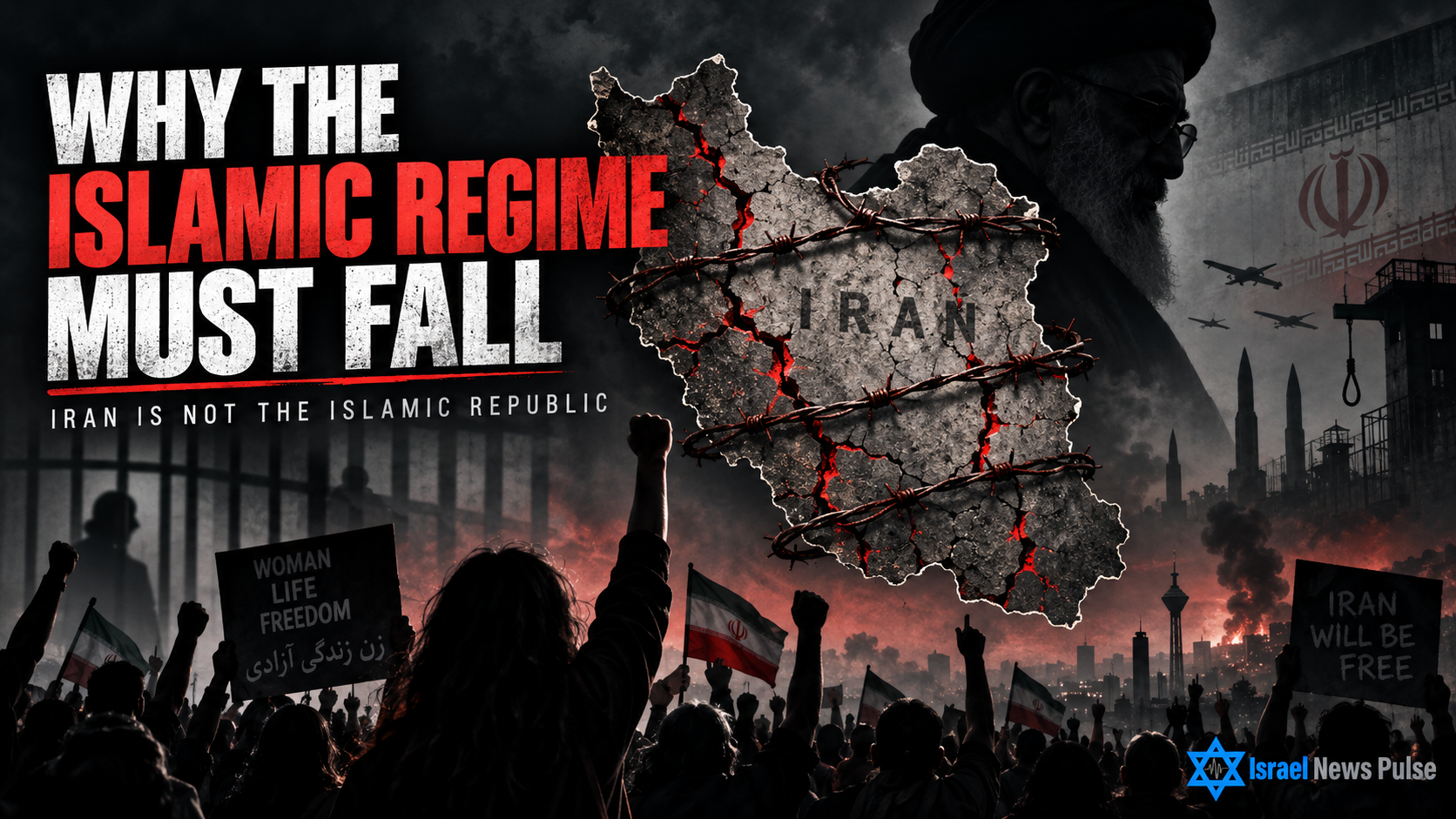
Iran is not the Islamic Republic.
Iran is a country, a civilization and a people with thousands of years of history. The Islamic Republic is a political system created in 1979 that has ruled Iran for less than half a century.
That distinction matters.
Because when people argue that the Islamic Republic must fall, the case should not be built on hostility toward Iran or Iranians. It should be built on what this regime has actually done to its own people, to the Middle East and increasingly to countries far beyond it.
And the record is staggering.
Start With What the Regime Does to Iranians
Iran Human Rights and Together Against the Death Penalty documented at least 1,639 executions in Iran during 2025.
That was a 68 percent increase from the previous year and the highest annual figure recorded since 1989.
The organization describes that number as an absolute minimum.
During the first six months of 2026, Iran Human Rights documented at least another 370 executions. Only 14 percent of them were publicly announced by Iranian authorities.
Ethnic minorities are hit particularly hard.
Baloch prisoners accounted for roughly 24 percent of documented drug related executions since 2021, despite Baloch people representing only an estimated 2 to 5 percent of Iran's population.
Kurds, Baloch, religious minorities, political prisoners and protesters have repeatedly faced arrest, execution and severe repression.
Christians have also faced a growing crackdown. A coalition of rights organizations documented 254 Christian arrests during 2025, with prison sentences totaling more than 280 years. Dozens more were detained after the June 2025 war.
This is not simply an authoritarian government with strict laws.
It is a system that uses imprisonment and execution as tools of political survival.
When Iranians Protest, the Regime Answers With Force
The pattern stretches across generations.
During the 2009 Green Movement, Iranian authorities acknowledged dozens of deaths while opposition groups documented more.
During the protests of 2017 and 2018, an Iranian parliamentarian said 4,900 people were arrested.
Then came November 2019.
Amnesty International documented at least 304 protesters killed during the crackdown. Iranian officials later acknowledged 230 deaths.
Reuters reported, citing three Iranian Interior Ministry officials and another official, that Supreme Leader Ali Khamenei told senior officials to do whatever was necessary to end the unrest.
The protests that erupted after the death of Mahsa Amini in 2022 brought another enormous crackdown.
A United Nations fact finding mission later concluded that Iranian authorities committed crimes against humanity, including killings, imprisonment, torture and sexual violence.
And the cycle continued.
Mass unrest returned again in 2025 and 2026 as economic hardship and opposition to the political system spread across the country.
The response was familiar: arrests, lethal force and communications blackouts.
A government confident that its people support it does not need to repeatedly shut down the internet when those people take to the streets.
The Regime Has Also Failed Iran Economically
The Islamic Republic likes to blame almost every economic problem on foreign sanctions.
Sanctions unquestionably hurt the Iranian economy and ordinary Iranians.
But they do not explain everything.
Iran's own Statistical Center reported extraordinary inflation during 2026. In the month ending August 22, urban prices were roughly 89 percent higher than a year earlier under one official measure.
Food inflation was even worse.
The Iranian rial, meanwhile, collapsed from roughly 950,000 to the US dollar in October 2025 to more than 2.1 million by early September 2026.
Youth unemployment stood at 23.4 percent according to Iran's own labor statistics.
Iran is one of the world's great energy powers, yet Iranians have endured electricity shortages, water shortages, deteriorating infrastructure and severe economic instability.
At the same time, the Islamic Revolutionary Guard Corps has built an enormous economic empire stretching across construction, oil and gas, transportation, mining, telecommunications and other sectors.
The precise percentage of Iran's economy controlled by the IRGC is impossible to verify and should not be exaggerated.
What is documented is that IRGC linked companies have received enormous state contracts, frequently with limited civilian oversight and little competitive bidding.
Iran's resources have not disappeared.
A political system has decided where they go.
Israel Is Not Imagining the Threat
The regime's hostility toward Israel is not an interpretation imposed on Tehran by its enemies.
Iranian leaders say it themselves.
Iranian lawmakers have repeatedly chanted "Death to America" and "Death to Israel" inside parliament.
In May 2026, Iran's new Supreme Leader, Mojtaba Khamenei, described Israel as a "cancerous tumor" approaching the final stage of its existence and reaffirmed the regime's prediction that Israel would not survive beyond 2040.
This ideology is backed by money, weapons and training.
The US Treasury states that Iranian support through the IRGC has provided Hamas and Palestinian Islamic Jihad with hundreds of millions of dollars in financial assistance as well as weapons and operational training.
Treasury also says the IRGC trained Palestinian Islamic Jihad fighters to build missiles in Gaza.
Iran's relationship with Hamas is similarly well documented. Hamas leaders themselves have publicly thanked Tehran for money, weapons and technical assistance.
Iran has also armed and supported Hezbollah and backed the Houthis in Yemen.
A United Nations panel investigating Yemen identified Iranian origin missile components and drones introduced after the UN arms embargo and found Iran in noncompliance with the relevant Security Council resolution.
These are not theoretical alliances.
They have produced wars, missile attacks, attacks on shipping and deaths across the region.
The Threat Does Not Stop in the Middle East
Iranian state activity abroad has repeatedly crossed into Europe.
The clearest example is Assadollah Assadi.
Assadi was an accredited Iranian diplomat stationed in Vienna.
A Belgian court sentenced him to 20 years in prison for his role in a plot to bomb a large Iranian opposition gathering near Paris in 2018.
He was eventually released to Iran in 2023 in exchange for Belgian aid worker Olivier Vandecasteele, who had been imprisoned in Iran.
Britain's domestic intelligence service, MI5, has also described a remarkable number of potentially lethal Iran backed plots.
In October 2024, MI5 Director General Ken McCallum said British authorities had responded to 20 Iran backed plots presenting potentially lethal threats since January 2022.
A year later, he said more than 20 additional potentially lethal plots had been tracked.
This is no longer simply an Israeli accusation about Iranian terrorism.
European security services are dealing with it themselves.
Even Many Iranians Reject the Regime's Ideology
Measuring public opinion inside an authoritarian state is extremely difficult.
Telephone surveys can make people afraid to answer honestly. Online surveys can overrepresent people who are younger, more educated or more politically engaged.
So no single poll should be treated as definitive.
But the available evidence is still revealing.
A large June 2026 GAMAAN online survey of more than 31,000 respondents inside Iran found only about 13 percent choosing the Islamic Republic as their preferred political system.
Around 62 percent opposed the slogan "Death to Israel."
Around 66 percent opposed continued confrontation with the United States.
Nearly 60 percent opposed Iran building nuclear weapons.
Those numbers come with methodological limitations and should be treated accordingly.
But they reinforce something visible on Iranian streets for years: the Islamic Republic's ideology should not automatically be confused with the beliefs of the Iranian people.
The regime chants "Death to Israel."
Many Iranians apparently do not.
That distinction matters enormously.
And Yes, What Comes Next Is Uncertain
There is one argument supporters of the status quo can make that deserves to be taken seriously.
Nobody knows with certainty what would replace the Islamic Republic.
Reza Pahlavi has significant support among parts of the Iranian public and diaspora, but there is no evidence that his movement currently possesses the organization inside Iran necessary to simply take control of the state.
Iran's opposition remains fragmented.
The IRGC could attempt to preserve the system under a more openly military government.
Parts of the security forces could fracture.
Ethnic tensions could worsen.
A badly managed collapse could create instability that lasts for years.
Those risks are real.
But uncertainty about what follows a dictatorship is not an argument that the dictatorship should continue indefinitely.
The question is not whether anyone can promise a perfect Iran the morning after the Islamic Republic disappears.
Nobody can.
The question is whether a system that executes its citizens on this scale, crushes political dissent, persecutes religious and ethnic minorities, wrecks the country's economy, finances armed groups across the Middle East, plots violence abroad and openly calls for another country's destruction deserves to survive simply because replacing it will be difficult.
After 47 years, the Islamic Republic has supplied its own answer.
Iran deserves better than the Islamic Republic.