
Nike’s $220 Billion Collapse: Did “Woke” Marketing Actually Cause It?
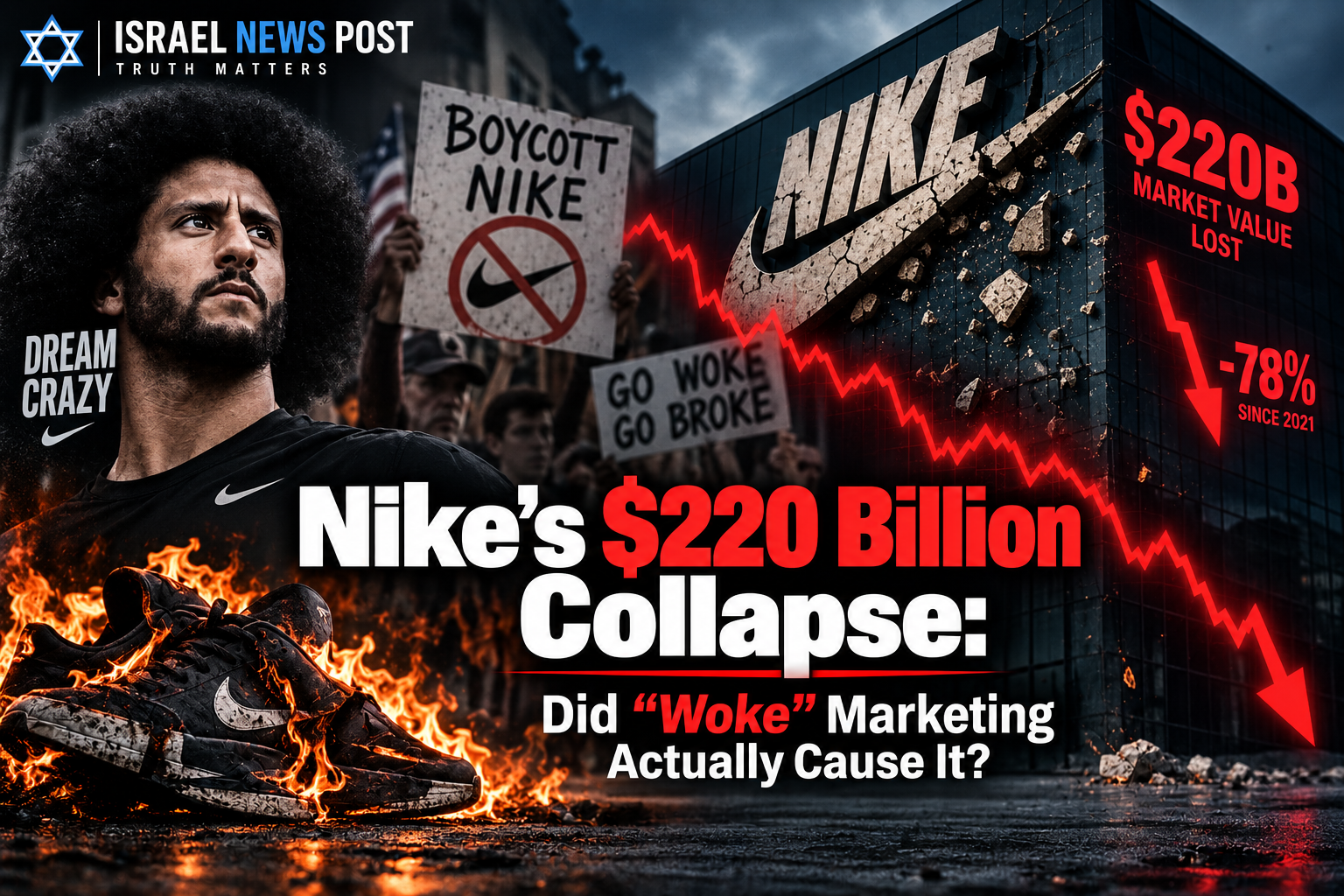
Nike is in serious trouble.
Its stock closed Friday at about $38, down roughly 78% from its 2021 record high. Around $220 billion in market value has disappeared.
Now another symbol of Nike's decline has arrived: after roughly 18 years, the company is being removed from the S&P 100 later this month.
Not the S&P 500, as some online claims have suggested. Nike remains there. But its fall from the S&P 100 is nevertheless remarkable for a company that was worth around $280 billion at its peak.
And it raises an obvious question.
What happened to Nike?
One increasingly popular explanation is that Nike went "woke" and eventually paid the price.
The company embraced Colin Kaepernick, racial justice campaigns, Pride collections, transgender influencer Dylan Mulvaney and diversity initiatives. It also aggressively courted Muslim consumers, launching the Nike Pro Hijab and advertising campaigns featuring Muslim and Arab women.
There were boycotts. There was outrage. There were plenty of predictions that Nike had alienated its customers.
But when you actually follow the money, there's a problem with that theory.
Nike went "woke" before it went up
Nike made Colin Kaepernick the face of its "Dream Crazy" campaign in September 2018.
The reaction was immediate. People filmed themselves burning Nike shoes. President Donald Trump attacked the campaign. Morning Consult polling reportedly showed Nike's net favorability plunging 34 points.
That sounds like the beginning of a corporate disaster.
It wasn't.
Nike's online orders jumped roughly 27% to 31% in the days surrounding the controversy, according to Edison Trends.
Within days, Nike's stock recovered.
Within weeks, the boycott was old news.
Then came the part that makes the "Kaepernick destroyed Nike" argument particularly difficult: Nike kept growing.
Revenue reached a then-record $39.1 billion in fiscal 2019. It reached $44.5 billion in 2021 and eventually peaked above $51 billion in 2024.
Nike's stock hit its all-time high in November 2021, more than three years after Kaepernick.
The same problem appears elsewhere.
Nike launched its Pro Hijab in 2017 and faced a genuine #BoycottNike campaign from critics who accused the company of normalizing the oppression of women.
Nike's revenue subsequently rose.
Its Pride collections had existed since 2012. Revenue subsequently more than doubled.
Nike partnered with transgender influencer Dylan Mulvaney in 2023, producing another wave of outrage. Nike then reported record annual revenue in fiscal 2024.
None of that proves these campaigns were good decisions.
It does show something important: there is no convincing financial evidence that they caused Nike's collapse.
So what did?
Something considerably less exciting than a culture war.
Nike appears to have made a massive business mistake.
Under CEO John Donahoe, the company aggressively pursued its "Consumer Direct Acceleration" strategy. Nike wanted customers buying shoes through Nike's own website, app and stores rather than through retailers.
So it pulled back from wholesalers.
That created an opportunity.
Walk into a sporting goods store and the shelf space Nike surrendered didn't remain empty. Hoka, On, New Balance and other competitors moved in.
Consumers discovered them.
Nike's own numbers now make the mistake painfully visible.
Nike Direct revenue peaked at roughly $22.4 billion in fiscal 2024. By fiscal 2026 it had fallen to about $18.2 billion.
Meanwhile, wholesale has started growing again.
In Nike's latest quarter, North American wholesale revenue increased 10%.
The channel Nike tried to escape is helping rescue the company.
Then Nike stopped making enough exciting shoes
Nike also developed another problem: too much dependence on yesterday's hits.
Air Force 1s. Dunks. Jordans. Familiar retro silhouettes that could be released again and again.
Meanwhile, Hoka and On were convincing runners to try something new.
Analysts increasingly began criticizing Nike's lack of product innovation. By August, Truist was warning that Nike's legacy styles were no longer resonating like they once did.
Footwear tells the story.
Nike footwear revenue peaked around $33.4 billion in fiscal 2024. It has since fallen by nearly $4 billion.
Consumers didn't stop buying sneakers.
They started buying somebody else's.
And then there's China
China has been brutal for Nike.
Greater China revenue has fallen from roughly $8.3 billion in fiscal 2021 to about $5.8 billion in fiscal 2026.
Interestingly, this is also where there is evidence that politics hurt Nike.
Nike expressed concern over reports of forced Uyghur labor in Xinjiang and said it did not source products from the region.
Chinese nationalists responded with a boycott.
In April 2021, Nike's sales on Alibaba's Tmall reportedly plunged 59% year over year.
Chinese celebrities severed relationships with the company, while domestic competitors including Anta and Li Ning benefited from a surge in patriotic consumer sentiment.
That doesn't mean the boycott explains Nike's entire subsequent China decline. Distribution problems, local competitors and changing Chinese tastes played major roles.
But unlike the American "go woke, go broke" argument, this case actually produced measurable evidence of political backlash hitting sales.
There's an irony there.
Nike's most clearly documented financial punishment for taking a political position came after it spoke out over allegations involving the treatment of Uyghur Muslims in China.
What about Nike's Muslim marketing?
Nike certainly made a deliberate effort to reach Muslim consumers.
Its 2017 "What Will They Say About You?" campaign featured Arab female athletes, including women wearing hijabs.
Then came the Nike Pro Hijab, a performance hijab developed with Muslim athletes.
The product generated controversy. Some critics accused Nike of promoting female oppression. Others accused it of cynical corporate pandering. #BoycottNike appeared online.
We specifically looked for evidence that these campaigns damaged Nike financially.
We couldn't find it.
No credible analyst report, Nike filing, earnings call, consumer study or sales dataset we reviewed connected Nike's Muslim-focused marketing to its later financial problems.
And the timing works against the theory.
Nike's revenue was about $34.4 billion in fiscal 2017.
By fiscal 2019 it had reached $39.1 billion.
By fiscal 2024 it was above $51 billion.
Whatever you think about the Pro Hijab, it doesn't explain a corporate collapse that began years later.
Nike really did lose its way
None of this means Nike's marketing deserves a free pass.
Some campaigns clearly alienated people.
Kaepernick caused a measurable collapse in general brand favorability before sales nevertheless increased. The Mulvaney partnership produced another backlash. Nike's DEI policies eventually attracted scrutiny from the Equal Employment Opportunity Commission, although an enforcement action seeking compliance with a subpoena was dismissed in August after Nike provided information.
And Nike's 2025 "So Win" Super Bowl commercial was criticized not only politically but creatively.
There is a reasonable argument that Nike became distracted, lost some of the universal confidence of "Just Do It," and occasionally sounded more interested in cultural conversations than selling great shoes.
That's a legitimate marketing debate.
It's just not the same thing as proving those decisions destroyed the company.
The financial evidence points somewhere else.
Nike pulled away from retailers.
Competitors took its shelf space.
Its product pipeline became stale.
Its direct-to-consumer bet stumbled.
China deteriorated.
Margins collapsed.
And consumers increasingly questioned whether expensive Nike shoes were worth the money.
Nike may have made plenty of controversial cultural decisions over the past decade.
But if you're looking for what erased roughly $220 billion from its peak market value, the evidence doesn't point primarily to "woke" advertising.
It points to something much more ordinary.
Nike made bad business decisions.