Saddam Knew He Couldn’t Beat America. Is Iran Trying to Win the Same Kind of War?
There is a strange way to win a war against a country you cannot defeat.
Stop defining victory as defeating it.
More than 35 years ago, Saddam Hussein entered a confrontation with the United States facing an enormous imbalance of military power. Iraq could hurt American forces. It could launch missiles. It could fight. But once the full weight of the American led coalition was brought against it, Iraq had little realistic prospect of defeating that coalition on the battlefield.
Saddam nevertheless believed there was another path.
Make the war last.
Make Americans pay.
Make the political cost rise.
And above all, survive.
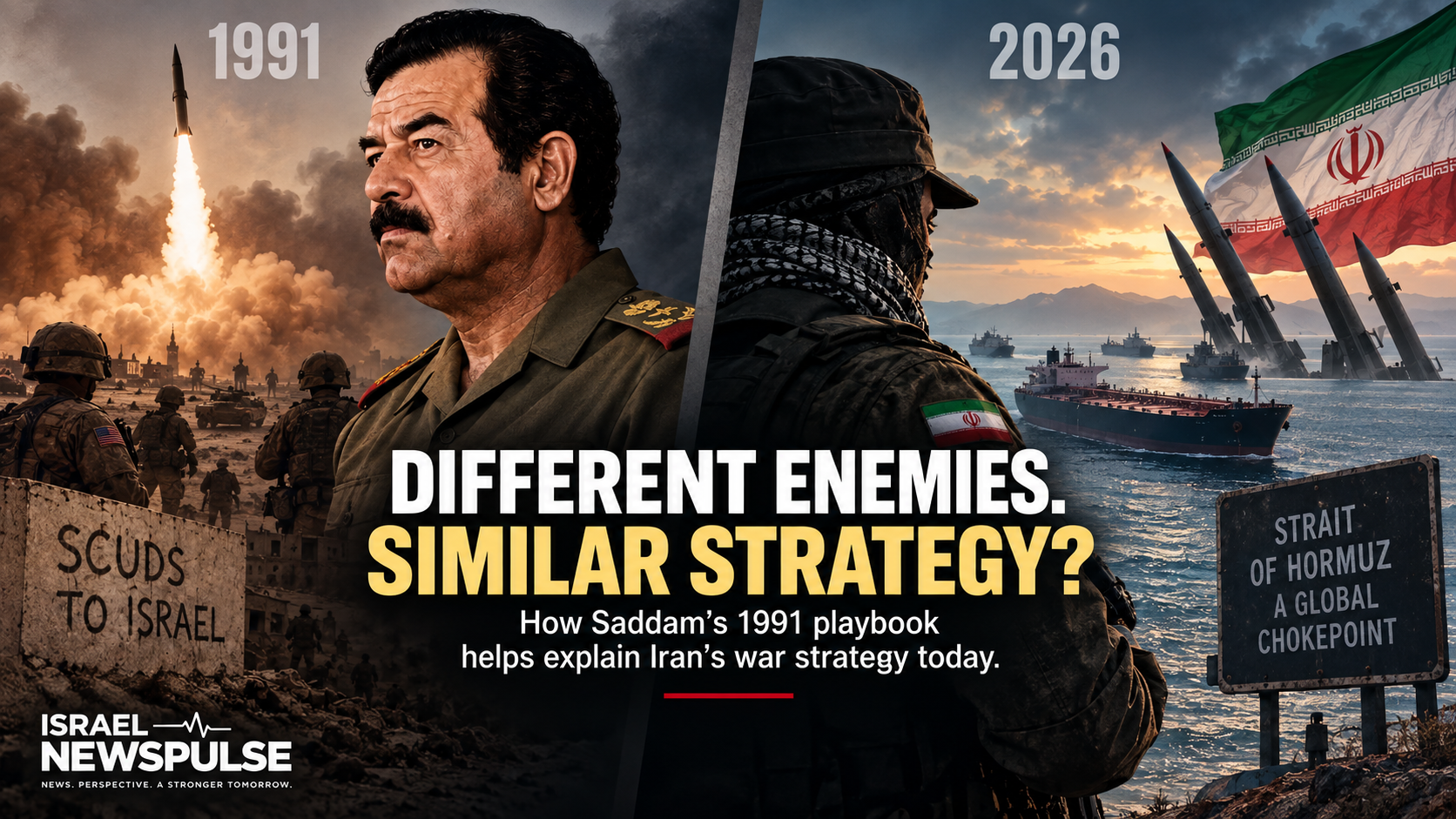
Today, as Iran confronts the United States and Israel in a very different war, an uncomfortable question is worth asking:
Is Tehran trying to accomplish something similar?
Not necessarily to defeat America militarily, but to remain standing long enough that survival itself can eventually be presented as victory.
The historical comparison is imperfect. In some important respects, Iran's position today is actually more complicated and potentially more powerful than Saddam's was in 1991.
But the similarities are difficult to ignore.
Saddam's Theory of America
Captured Iraqi records provide an unusually detailed picture of what Saddam believed before the 1991 Gulf War.
He thought Americans were extremely sensitive to casualties.
In February 1990, Saddam pointed to the American withdrawal from Lebanon after the killing of US Marines in Beirut as evidence that the United States would retreat when the human cost became painful.
Vietnam was another reference point inside the Iraqi leadership.
Then, in April 1990, months before Iraq invaded Kuwait, Saddam told Yasser Arafat that Iraq was prepared for a confrontation that could continue indefinitely.
"How many years is it going to last? Let it last!" he said, according to a captured Iraqi recording later examined by the Iraqi Perspectives Project.
This was not merely rhetoric after the war had gone badly.
By November 1990, with hundreds of thousands of coalition troops gathering in the region, Saddam was explicitly telling his commanders that Iraq had planned for a prolonged conflict.
"The enemy is planning to shorten the battle, which we planned to prolong," he said.
His preferred battlefield was also revealing.
Saddam wanted the Americans on the ground.
"What we want is to have the enemy engage us in a land battle," he told his commanders.
He believed Iraq could absorb enormous casualties and still prevail politically if it inflicted enough losses on the other side. In one captured statement, Saddam argued that even if Iraq suffered two or three times the enemy's losses, Iraq could still be winning.
The calculation was brutal but straightforward.
America had more aircraft, more advanced weapons, greater economic power and overwhelming conventional superiority.
Iraq, Saddam believed, had something else: a greater willingness to suffer.
He Was Wrong About the War, But He Survived It
Much of Saddam's military analysis turned out to be disastrously wrong.
The coalition air campaign devastated Iraqi forces. The ground offensive did not become the prolonged bloodbath Saddam had hoped for. Coalition forces expelled Iraq from Kuwait with extraordinary speed.
His assumptions about American casualty tolerance had also been deeply flawed.
There is another danger in retrospectively turning Saddam into a master strategist. The captured Iraqi record reveals extraordinary dysfunction alongside the strategic thinking. Iraq had no proper retreat plan. Senior officers were excluded from critical decisions. Iraqi commanders badly underestimated American capabilities.
This was not a brilliantly executed strategy.
It was a dictatorship making enormous strategic mistakes while trying to find a political route through military inferiority.
Yet one fact remained when the shooting stopped.
Saddam Hussein was still in Baghdad.
The Iraqi Perspectives Project later summarized his concept of victory in remarkably simple terms: Saddam defined victory as not losing in the face of overwhelming odds.
By that peculiar definition, he survived the 1991 confrontation.
Iraq did not.
Kuwait was lost. Much of the Iraqi military was destroyed. Sanctions and international containment followed. Iraq suffered enormously during the following decade.
But the regime remained.
For Saddam, that distinction mattered.
Then Came the Missiles Against Israel
One of Saddam's most consequential moves during the Gulf War was his decision to fire Scud missiles at Israel.
The conventional explanation is familiar.
The coalition assembled against Iraq included Arab governments. If Israel entered the war and attacked Iraq, Saddam hoped the political position of those Arab governments would become far more difficult.
Israel therefore faced an extraordinary strategic decision.
It was being attacked, yet Washington desperately wanted it to remain outside the war.
Israel ultimately exercised restraint.
Saddam's gambit failed.
But there is an important historical qualification.
The evidence for exactly what Saddam intended is less clean than the popular version of the story suggests. Years later, during FBI questioning, Saddam accepted personal responsibility for ordering the missile attacks and said he believed the United States might stop the war if Israel was hurt. But he denied that provoking an Israeli response and breaking the Arab coalition was his objective.
That later testimony cannot simply settle the question either.
What can be said with much greater confidence is that Saddam was trying to transform a battlefield he could not dominate into a broader political contest.
And that brings us back to Iran.
Iran Does Not Need to Defeat the United States
Iran in 2026 is not Iraq in 1991.
There is no captured Iranian archive giving outsiders the same window into Tehran's internal thinking that historians now have into Saddam's government.
That distinction matters.
We should therefore be careful about claiming that Iran has consciously adopted a documented "survive long enough to win" doctrine.
But its behavior and public statements raise the possibility.
Iranian Brigadier General Mohammad Reza Naqdi has publicly said: "The longer this war lasts, the more experience we gain."
Outside analysts have reached similar conclusions about the logic facing Tehran. Daniel Byman of the Center for Strategic and International Studies has argued that Tehran may believe that simply surviving the bombing allows it to achieve important objectives.
That sounds remarkably familiar.
The weaker side does not need to destroy the stronger side's military.
It needs to remain capable of fighting after the stronger side expected the conflict to end.
But Iran Has Something Saddam Never Had
This is where the comparison begins to break down.
Saddam could fire missiles at Israel and Saudi Arabia. He could threaten American troops. He could attempt to manipulate the politics of the coalition.
Iran possesses another form of leverage entirely.
The Strait of Hormuz.
The waterway is not simply another battlefield. It is one of the world's most important energy arteries.
Iran has managed to make control, policing and freedom of navigation through Hormuz a central issue in the conflict.
That matters because the costs are no longer confined to the countries actually fighting.
Shipping companies, energy markets, Asian importers, Gulf states and governments thousands of kilometers from Iran can all have interests affected by what happens there.
In other words, Tehran does not necessarily have to inflict a decisive military defeat on the United States to create pressure.
It can attempt to make continuation of the war expensive for everyone else.
The available evidence suggests that this strategy has produced mixed results.
Iran has imposed costs and forced other countries to devote resources to protecting shipping. But Gulf states have not simply moved toward Tehran, and major powers dependent on the strait have strong reasons to want normal navigation restored rather than Iranian control institutionalized.
Still, Saddam could only dream of possessing economic leverage on this scale.
There Is Another Difference: America and Israel
Saddam is often remembered as trying unsuccessfully to fracture the coalition confronting him.
The picture in 2026 is different.
The Gulf states have not fractured in the way such a strategy might require.
But visible differences have emerged between Washington and Jerusalem over what victory actually means.
American war aims have shifted considerably during the conflict, from destroying Iranian military capabilities and permanently denying Tehran nuclear weapons to the increasingly central question of reopening the Strait of Hormuz.
Israel's stated objective has been more expansive.
Prime Minister Benjamin Netanyahu has tied victory to the fall of the Iranian regime.
That creates a potentially enormous distinction.
If the United States eventually decides that an agreement restoring navigation through Hormuz and addressing its principal security demands is sufficient, while Israel continues to define victory as regime collapse, Tehran does not need to manufacture that disagreement.
It already exists.
So What Would Iranian "Victory" Actually Look Like?
This is where the definition of winning becomes crucial.
Imagine a future agreement in which Iran's military has suffered enormous damage.
Its economy has been battered.
Its missile infrastructure has been hit.
Its nuclear capabilities have been degraded.
Its regional position has weakened.
But the Islamic Republic remains in power.
Would Iran have won?
By a conventional military definition, probably not.
By Saddam Hussein's definition, the answer becomes considerably less obvious.
For a regime whose survival is threatened, remaining alive can itself become the victory condition.
Iran could tell its population and the wider region that the United States and Israel unleashed enormous military power against the Islamic Republic and still failed to destroy it.
That narrative does not require Iran to defeat an American army.
It requires the Iranian regime to still exist when the war ends.
Survival Is Not the Same as Success
There is one final lesson from Saddam that Tehran would be wise to remember.
Saddam survived 1991.
That did not mean his strategy ultimately succeeded.
His army was shattered. Iraq entered years of sanctions and international isolation. His country was impoverished. His regime survived another twelve years before the United States returned in 2003 and removed him from power.
Political survival can coexist with national catastrophe.
That may ultimately be the most important part of the comparison.
Saddam discovered that a weaker regime facing overwhelming American military power could survive a war it had clearly lost on the battlefield.
But survival did not erase the consequences of defeat.
Iran may now be testing a modern version of the same proposition, with one major advantage Saddam never possessed: the ability to impose economic costs far beyond the immediate battlefield through the Strait of Hormuz.
Whether that leverage can turn survival into an acceptable political settlement remains unanswered.
But if Tehran's ultimate objective is no longer to defeat the United States or Israel militarily, the question we should be asking may be different.
Not whether Iran can win this war.
But whether it can remain standing long enough to make everyone else decide that continuing it is no longer worth the price.