
On the morning of September 11, 2001, thousands of people went to work in Lower Manhattan.
Passengers boarded early flights from Boston, Newark and Washington. Office workers bought coffee. Elevators carried employees toward offices high above New York. Firefighters at Battalion 1 were investigating a reported gas leak.
There was no warning for the people living that morning.
At 8:46 a.m., everything changed.
American Airlines Flight 11 slammed into the North Tower of the World Trade Center.
People across Manhattan looked upward.
Smoke poured from a hole high in the building. Television cameras turned toward Lower Manhattan. Newsrooms initially tried to understand whether they were watching a terrible aviation accident.
They were not.
Seventeen minutes later, another passenger aircraft appeared over New York.
At approximately 9:03 a.m., United Airlines Flight 175 crashed into the South Tower in front of television cameras broadcasting live around the world.
There could no longer be any doubt.
America was under attack.
Before the morning was over, four commercial aircraft would be hijacked. The World Trade Center would be destroyed. The Pentagon would be burning. Another aircraft would lie shattered in a Pennsylvania field.
A total of 2,977 victims would be killed.
But the story of September 11 is not only the story of the 19 al Qaeda terrorists who carried out the attacks.
It is also the story of what thousands of ordinary people did after they realized what was happening.
Some carried strangers down staircases.
Some climbed upward into buildings that everyone else was desperately trying to leave.
Some stayed beside people who could not escape alone.
And aboard one aircraft, a group of passengers eventually reached a terrifying conclusion.
If they did nothing, they were probably going to die anyway.
So they decided to fight.
The Plan to Turn Passenger Aircraft Into Weapons
The attacks had been years in the making.
According to the 9/11 Commission, Khalid Sheikh Mohammed brought Osama bin Laden a proposal involving trained pilots crashing aircraft into buildings in the United States.
Bin Laden eventually approved what al Qaeda called the “planes operation.”
The original concept was even larger than the attack ultimately carried out. Khalid Sheikh Mohammed described a plan involving as many as ten aircraft and targets across the United States.
The operation was eventually reduced.
The World Trade Center, Pentagon, White House and U.S. Capitol were among the targets considered.
By September 2001, 19 al Qaeda terrorists were in position.
Fifteen were Saudi citizens. Two came from the United Arab Emirates. One was Lebanese and one Egyptian.
Four teams would hijack four passenger aircraft.
The terrorists were not simply trying to destroy airplanes.
The airplanes themselves were the weapons.
American Airlines Flight 11
American Airlines Flight 11 departed Boston for Los Angeles at 7:59 that morning.
There were 92 people aboard, including five hijackers.
At approximately 8:14 a.m., the hijacking began.
Five minutes later, flight attendant Betty Ong managed to reach American Airlines by Airfone.
Her call would become one of the first windows into what was happening in the sky.
She reported that flight attendants had been stabbed. A passenger had also been stabbed. The cockpit was not responding.
Another flight attendant, Amy Sweeney, also communicated information from the aircraft.
The passenger identified in airline communications as possibly having been fatally stabbed was seated in 9B.
Daniel Lewin
Lewin was 31 years old, an American Israeli technology entrepreneur, cofounder of Akamai Technologies and a former officer in the Israeli military.
He was sitting immediately behind hijackers Mohamed Atta and Abdulaziz al Omari and directly in front of Satam al Suqami.
What happened in those first violent moments has become the subject of repeated retellings.
The evidence supports that Lewin was stabbed early in the hijacking. It does not establish with certainty that he attacked the hijackers or deliberately attempted to stop them. The 9/11 Commission treated that possibility as an inference rather than a confirmed fact.
That distinction matters.
There is no need to embellish September 11.
The documented reality is terrible enough.
The hijackers apparently intended the announcement for the passengers.
Instead, they transmitted it over the radio.
Twenty two minutes later, Flight 11 reached Manhattan.
At 8:46 a.m., it struck the North Tower.
Everyone aboard was killed.
Inside the North Tower
The aircraft tore through floors 93 through 99.
The impact destroyed every usable stairway through the impact zone.
For people trapped above it, there was no conventional route down.
The roof was not an escape route either. Its doors were locked, there was no rooftop evacuation plan, and smoke and fire made helicopter rescue impossible.
Below the impact, however, something enormous was happening.
Thousands of people were evacuating.
in the Twin Towers
the towers
below impact floors
Hingson & Roselle
NIST estimated that approximately 17,400 people were inside the Twin Towers when the first aircraft struck.
Ultimately, approximately 87 percent of the people inside the towers escaped. Among those below the impact floors, the survival rate was approximately 99 percent.
That statistic represents thousands of individual decisions.
People walked down dozens of flights of stairs.
They held doors.
They guided colleagues through smoke.
They waited for people who moved more slowly.
Michael Hingson & Roselle
Michael Hingson was working on the 78th floor of the North Tower. He had been blind since birth. His guide dog, Roselle, had been sleeping beneath his desk when the aircraft struck.
Together, they began descending.
Seventy eight floors.
Roselle remained calm, and Hingson and the dog made their way out before the North Tower collapsed.
Elsewhere in the building, Abraham Zelmanowitz faced a different decision.
His colleague Edward Beyea was quadriplegic.
Zelmanowitz could have attempted to save himself.
Instead, he stayed with Beyea on the 27th floor.
Neither man survived.
President George W. Bush would later cite Zelmanowitz as an example of the sacrifice witnessed inside the towers that morning.
The Firefighters Began Climbing
The first FDNY response began within seconds.
Chief Joseph Pfeifer and members of Battalion 1 had actually witnessed the aircraft hit while investigating a gas leak nearby.
The alarms escalated rapidly.
By 9:00 a.m., roughly 235 firefighters had already been dispatched to the World Trade Center.
Then came one of the defining images of September 11.
Firefighters were walking up.
They carried protective clothing, hoses, axes, oxygen tanks and other equipment as they climbed floor after floor.
They did not know that either tower would collapse.
They did know that people were trapped above them.
FDNY Division Chief Peter Hayden later explained the calculation facing commanders. They understood firefighters could be lost, but believed tens of thousands of civilians might need rescue.
So they kept going.
Then the Second Plane Appeared
The South Tower had not yet been hit.
And that created one of the most consequential windows of the entire morning.
After the North Tower was struck, many occupants of the South Tower began leaving.
Others were told that their building was secure and that they could remain or return to their offices. A later announcement said people could begin an orderly evacuation if conditions warranted it.
Many ignored the initial advice to remain.
That decision saved an extraordinary number of lives.
NIST concluded that roughly three quarters of the people who had been above the eventual South Tower impact zone had already moved below it before the second aircraft arrived. The combination of immediate evacuation and elevator use saved roughly 3,000 lives.
Then, at approximately 9:03 a.m., United Airlines Flight 175 hit.
The aircraft ripped through floors 77 through 85 of the South Tower.
Everyone aboard was killed.
More than 300 people inside the tower were killed immediately.
But unlike the North Tower, one staircase through the impact area remained passable.
Eighteen people from above the impact zone eventually escaped through it.

The Man in the Red Bandana
Welles Remy Crowther
Among the people inside the South Tower was a 24 year old equities trader. Survivors would remember him because of a red bandana covering his face.
Crowther repeatedly helped people escape from the devastated area around the 78th floor sky lobby.
He guided survivors toward the remaining staircase.
Then he went back.
Judy Wein was badly injured, suffering a shattered arm, broken ribs and a punctured lung.
She survived.
Crowther did not survive.
His identity as the mysterious man in the red bandana was established only later, when survivors’ descriptions reached his family.
He had been carrying a red bandana since childhood.
Rick Rescorla Had Prepared for This
There was another man in the South Tower who understood something was terribly wrong almost immediately.
Rick Rescorla
A Vietnam veteran, Rescorla had spent years worrying about the vulnerability of the World Trade Center.
When the North Tower was attacked, he did not simply wait.
He began getting Morgan Stanley employees out.
The company occupied 22 floors of the South Tower.
Rescorla and his security operation had repeatedly drilled employees on evacuation procedures. Now the drills became real.
Of approximately 2,700 Morgan Stanley employees in the building, 2,687 were evacuated.
Rescorla was not among them.
He continued moving through the building helping others leave.
He never came home.
The Pentagon
While New York was burning, another hijacked aircraft was approaching Washington.
American Airlines Flight 77 had departed Washington Dulles International Airport for Los Angeles.
There were 64 people aboard, including five hijackers.
At 9:37 a.m., Flight 77 struck the western side of the Pentagon.
There were roughly 20,000 people inside the building.
The impact ripped through the structure and ignited an enormous fire.
A total of 184 victims were killed at the Pentagon and aboard Flight 77.
But once again, the minutes after impact produced extraordinary acts of rescue.
Army cook Staff Sergeant Christopher Braman entered the damaged area.
Inside, Sheila Moody was trapped in smoke and unable to call out effectively.
So she began clapping.
Braman heard her.
He fought his way toward the sound, dealt with flames between them and helped bring her out.
Elsewhere, military personnel and civilians repeatedly entered damaged areas looking for colleagues.
The building itself remained unstable.
At approximately 10:15 a.m., part of the Pentagon above the impact area collapsed.
The Last Hijacked Plane
United Airlines Flight 93 left Newark for San Francisco 42 minutes late.
That delay would change history.
There were 44 people aboard, including four hijackers.
By the time the terrorists seized the aircraft at approximately 9:28 a.m., the attacks in New York had already happened.
And unlike the passengers on the earlier aircraft, people aboard Flight 93 were able to learn what had happened.
Thirty seven telephone calls were placed from the aircraft between the hijacking and the crash.
Passengers and crew spoke with husbands, wives, parents and operators on the ground.
Through those conversations they learned that aircraft had struck the World Trade Center and Pentagon.
The assumptions that had governed hijackings for decades no longer applied.
This was not a conventional hijacking.
The terrorists were not trying to negotiate.
The aircraft itself was a weapon.
And the people aboard Flight 93 understood that.
Tom Burnett told his wife that a group of passengers was preparing to do something.
Jeremy Glick told his wife that passengers were voting on whether to rush the cockpit and retake the aircraft.
Todd Beamer remained connected to an Airfone operator.
The famous phrase associated with him, “Let’s roll,” comes from operator Lisa Jefferson’s account of the conversation. The call itself was not recorded, and the phrase should not be described as something recovered from the aircraft’s cockpit recorder.
What is recorded is the battle that followed.
They Fought Back
At approximately 9:57 a.m., the passengers began their counterattack.
The cockpit voice recorder captured crashes, shouting and breaking glass.
Hijacker pilot Ziad Jarrah violently moved the aircraft from side to side and pitched its nose up and down in an attempt to throw the passengers off balance.
They continued.
At 10:00:26, an unidentified passenger can be heard saying:
Seconds later another voice shouted:
The identities of the people whose voices appear on the recording cannot be established.
The evidence also does not prove that the passengers physically entered the cockpit or reached the controls.
What the 9/11 Commission concluded was that the hijackers apparently believed the passengers were only seconds from overcoming them.
At 10:02 a.m., the terrorists decided to crash the aircraft.
At 10:03 a.m., United Flight 93 slammed into an empty field near Shanksville, Pennsylvania.
All 40 passengers and crew members were killed.
The aircraft was still roughly 20 minutes from Washington.
The precise intended target cannot be established with absolute certainty from the final moments of the flight, although the U.S. Capitol and White House had both been considered in the plot.
Whatever building the hijackers intended to strike, they never reached it.
The passengers had changed the outcome.
The South Tower Falls
Back in New York, firefighters were still climbing.
Civilians were still descending.
Then, at 9:58:59 a.m., the South Tower collapsed.
It had been struck second.
It fell first.
The collapse destroyed the FDNY command post on West Street and killed civilians and emergency personnel in and around the building.
Father Mychal Judge, the FDNY chaplain, had earlier anointed firefighter Daniel Suhr after Suhr was fatally injured. Judge subsequently returned to the North Tower lobby.
He was killed there by debris when the South Tower came down.
Stories later grew around his death, including the claim that he died while administering last rites. The documented chronology is slightly different.
Again, the truth requires no embellishment.
Get Out of Tower One
After the South Tower disappeared, the danger facing firefighters inside the North Tower became horrifyingly clear.
Evacuation orders went out.
But communications were imperfect. Radio traffic was overwhelming. Some firefighters never received the warnings.
Others were already many floors above ground.
They now had to descend carrying the same heavy equipment they had carried upward.
At 10:28:25 a.m., the North Tower collapsed.
It had stood for 102 minutes after Flight 11 hit it.
Then it was gone.
Hundreds of firefighters, police officers and other rescuers were killed.
killed
killed
officers killed
killed
In total, 441 first responders from more than 30 agencies died on September 11.
Among them were 343 members of the FDNY.
Thirty seven Port Authority police officers were killed.
Twenty three NYPD officers were killed.
Entire firehouse communities were shattered.
The FDNY lost senior commanders, veterans, rookies, fathers, sons and members of entire units.
The People Who Survived Inside the Collapse
Yet even inside the collapse, there were survivors.
In Stairwell B of the North Tower, a group including firefighters, a Port Authority police officer and civilians survived as the building came down around them.
Among them was Josephine Harris.
Harris had injured her leg before September 11 and could not descend quickly.
Firefighters from Ladder 6 encountered her around the 20th floor and stayed with her.
Her slow pace delayed them.
That delay may have saved their lives.
When the tower collapsed, the section of Stairwell B where the group had reached survived within the destruction.
Firefighter Matt Komorowski later described Harris as their “guardian angel.”
When Harris died in 2011, six firefighters served as pallbearers.
Manhattan Became an Island People Needed to Escape
On the streets, Lower Manhattan was buried beneath dust.
Transportation networks were disrupted.
Bridges and tunnels were closed or restricted.
Hundreds of thousands of people needed a way out.
Then came one of the least remembered large scale responses of September 11.
The boats arrived.
The Coast Guard put out a call across New York Harbor asking available vessels to assist with the evacuation of Lower Manhattan.
Ferries came.
Tugboats came.
Tour boats came.
Private vessels came.
Crews that had begun the morning expecting an ordinary day suddenly found themselves loading frightened strangers from Manhattan and carrying them across the water.
Nearly half a million people were evacuated by boat according to widely cited estimates.
The Staten Island Ferry alone carried tens of thousands.
Some vessels brought emergency workers and supplies back toward the burning city.
While thousands were trying to escape Manhattan, others were voluntarily sailing toward it.

The final human toll of the September 11 attacks was 2,977 victims, excluding the 19 hijackers.
They came from 90 nations.
There were 2,753 victims in New York.
There were 184 at the Pentagon and aboard Flight 77.
Forty passengers and crew members died aboard Flight 93.
On American Airlines Flight 11, 87 victims were killed.
On United Airlines Flight 175, 60.
On American Airlines Flight 77, 59.
On United Airlines Flight 93, 40.
Behind those numbers were thousands of unfinished lives.
Parents who never picked their children up again.
People who had changed flights.
People who arrived early for work.
People who arrived late.
People who went upstairs because somebody needed help.
People who went downstairs because instinct told them not to wait.
And people whose survival came down to a decision made in seconds.
The Attacks Did Not End When the Towers Fell
For rescuers, construction workers, police officers, firefighters and families, September 11 did not end on September 11.
The World Trade Center recovery operation continued until May 30, 2002.
For months, workers searched through the site.
And the health consequences continued long afterward.
Thousands of responders and survivors have been treated through programs created for illnesses associated with exposure to the World Trade Center disaster.
The number of people affected by September 11 therefore extends far beyond those who died that morning.
Its consequences have continued for a quarter century.
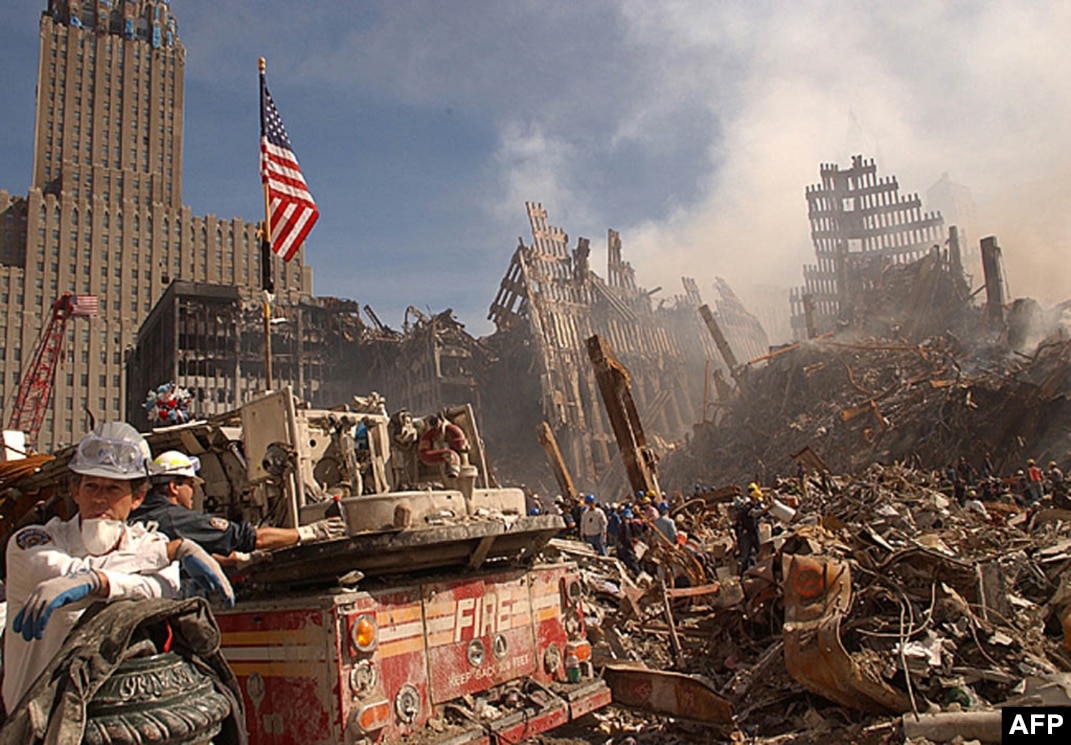
What Happened That Morning
September 11 is sometimes compressed into four images.
A burning tower.
A second aircraft.
A collapsing building.
A field in Pennsylvania.
But those images are only the outline.
Inside them were thousands of individual stories.
Betty Ong used an aircraft telephone to tell the outside world what was happening aboard Flight 11.
Michael Hingson and Roselle descended 78 floors.
Abraham Zelmanowitz stayed with Edward Beyea when leaving him behind might have given Zelmanowitz a chance to live.
Welles Crowther repeatedly returned toward danger to help strangers escape.
Rick Rescorla ignored reassurance that the South Tower was safe and pushed thousands of employees toward the exits.
Christopher Braman followed the sound of a trapped woman’s hands clapping inside the burning Pentagon.
Firefighters climbed toward people they had never met.
Mariners turned their boats toward Lower Manhattan.
And aboard Flight 93, passengers who had learned what the terrorists intended decided that waiting was no longer an option.
None of them knew how September 11 would be remembered.
They were simply people making decisions under circumstances almost impossible to imagine.
That is perhaps the most important thing to remember about the attacks.
Nineteen al Qaeda terrorists came to the United States with a carefully prepared plan to turn civilian aircraft into weapons and murder as many people as possible.
They succeeded in killing 2,977 innocent people.
But September 11 also produced thousands of decisions the terrorists did not control.
A firefighter taking another step upward.
A man refusing to abandon a disabled colleague.
A security director going back for more employees.
A boat turning toward the smoke.
And passengers at the back of an aircraft deciding to fight.
The terrorists determined how that morning began.
They did not determine every part of how people responded.

