Stefan Tompson, Visegrád24 and the Turn Toward Israel After October 7
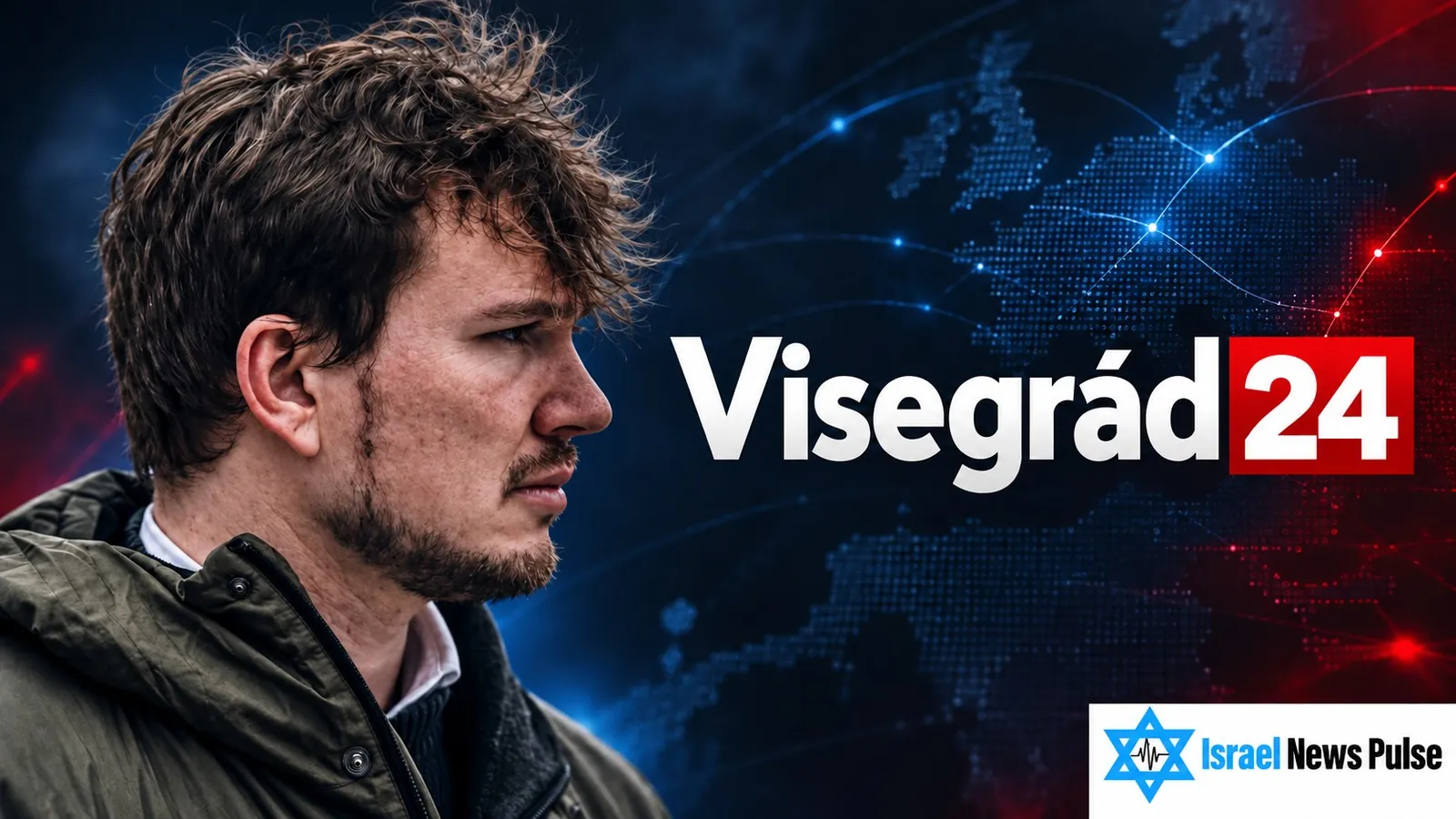
A London-born Polish-South African helped turn a Central European social media account into a prominent pro-Israel platform. Its growth reveals both the power of digital distribution and the limits of measuring influence in views.
Stefan Tompson did not start Visegrád24 to cover Israel. The account began in 2020 with Central Europe at its core, gained international visibility during Russia’s invasion of Ukraine, and then made Israel a defining focus after the Hamas-led attack on October 7, 2023.
That shift put a small media operation inside a much larger argument: who gets to explain a war to an international audience, and why do some voices travel further than others?
Tompson, a London-born Polish-South African, became the public face of an account whose name was often better known than the people behind it. His support for Israel is explicit. Understanding the project means looking at that conviction alongside its audience, methods and finances.
From London to Warsaw
Tompson studied at University College London before moving to Warsaw around 2014 and building a career in public relations. His family background spans Poland and South Africa; his upbringing also connected him to Britain and France.
His Catholic faith and Polish identity help explain the framework through which he discusses Israel. In interviews, he has presented the Jewish state as part of a shared Western and Judeo-Christian civilization. That is his political and religious interpretation, rather than a neutral description of the conflict.
It also makes the trajectory less abrupt than it first appears. Israel became much more prominent in Visegrád24’s output after October 7, but Tompson’s interest in Polish-Jewish history and the relationship between Jews and Christians predates the war.
A regional account finds an international audience
Visegrád24 began as an anonymous account focused on Central and Eastern Europe. Short posts, photographs and video made regional stories accessible to English-speaking users without requiring them to follow Polish-language media.
Russia’s full scale invasion of Ukraine in February 2022 widened that audience. The account’s support for Ukraine also established a recognizable editorial approach: distribute news quickly while making clear which side it supports.
After October 7, that approach carried into coverage of Israel, the hostages and the war against Hamas. Reports, clips and statements placed Israeli experiences in front of audiences far beyond Israel. Advocacy was part of the presentation, not an incidental feature.
What 371 million views actually tells us
An October 2023 study from the University of Washington’s Center for an Informed Public recorded 371,770,355 views across 399 relevant Visegrád24 posts, the highest total among seven selected influential accounts.
That is a striking measure of distribution. It is not a count of distinct people, an assessment of accuracy or proof that viewers changed their minds. Nor should a ranking within that selected group become a claim that the account led all international media.
Those limits do not erase the achievement. They identify it more precisely: Visegrád24 had become exceptionally effective at putting war related material into the social media conversation.
Why Israel became central
During a January 2024 visit to Israel, Tompson brought his coverage closer to the people affected by the war. Jewish Insider reported on that trip and his explanation of Israel’s place in his broader worldview.
He regards support for Israel as connected to the security and cultural future of the West. In that reading, events in Israel are not distant from Europe’s interests. They belong to the same struggle.
Readers need not share that interpretation to understand its editorial consequences. It helps explain the sustained attention to Hamas, antisemitism, Israeli hostages and the threats posed by Iran and its allies. The account’s priorities reflect a mission as well as a news agenda.
A nonprofit structure, with questions that remain distinct
Visegrád24 identifies the US nonprofit Intermarium Foundation as the organization supporting its work. The foundation’s 2024 tax data, published by ProPublica, records $852,312 in revenue, $446,131 in expenses and $436,156 in net assets. Contributions accounted for $852,125 of revenue.
These are foundation level figures for one financial year. Revenue is not the same as spending, and the filing does not establish the budget of every associated media project or identify every underlying donor.
Polish state funding questions require a separate distinction. A 2022 grant of 1,396,800 zloty was approved for the separate Action-Life Foundation for a project named Visegrad24, but reporting says that grant was cancelled before an agreement was signed. Tompson has denied receiving Polish state money to run Visegrád24.
OKO.press also reported CEE News links to Tompson’s company, without establishing a transfer to Visegrád24. Cancelling one grant therefore does not settle every question about connected projects; reported connections alone do not establish where money ultimately went.
Reach brings responsibility
Visegrád24’s rise shows how a small operation can become a major distributor of international news without the infrastructure of a broadcaster. It also makes the distinction between reporting, aggregation and advocacy more important for readers.
Speed can bring overlooked material to a wider audience. It can also carry mistakes further before they are corrected. Views measure exposure, while credibility depends on sourcing, verification and the handling of errors.
October 7 did not create Tompson’s worldview. It gave that worldview a new central subject and Visegrád24 a much larger role in the debate about Israel. The most useful way to understand that role is to examine both what the platform helps audiences see and the perspective through which it asks them to see it.