What Is Yom Kippur? Why Jews Fast, What the Torah Says, and How the Day Shaped Israel
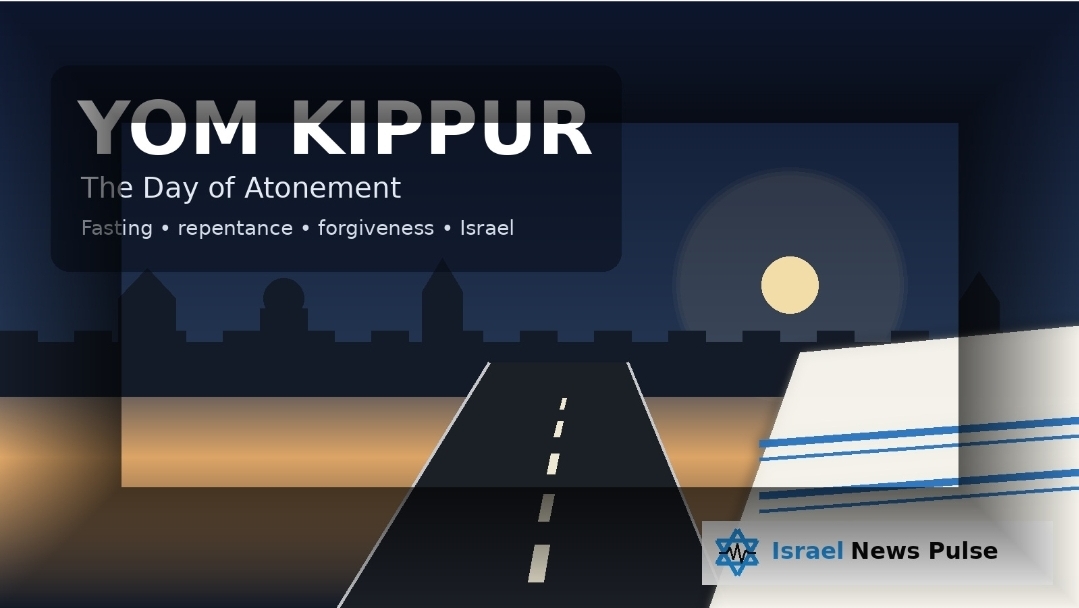
For roughly 25 hours each year, ordinary Jewish life stops.
There is no food or water for those able to fast. Work stops. Synagogues fill. In Israel, highways that are normally packed with traffic become almost empty, children take bicycles into the streets, television schedules disappear and much of the country becomes unusually quiet.
But Yom Kippur is not simply a Jewish fasting day.
It is the Day of Atonement, a day built around repentance, confession, responsibility, forgiveness and the possibility of changing what comes next.
And there is something important about Yom Kippur that is sometimes lost in simple explanations of the holiday: being hungry is not the point.
When is Yom Kippur 2026?
Yom Kippur falls on the 10th day of the Hebrew month of Tishrei.
In 2026, Yom Kippur begins before sunset on Sunday, September 20, and ends after nightfall on Monday, September 21.
Exact start and end times vary by location and religious calculation. In Tel Aviv, for example, Chabad lists candle lighting at 6:18 p.m. on September 20 and the end of the holiday at 7:15 p.m. on September 21.
What does Yom Kippur mean?
Yom Kippur, יום כיפור, means the Day of Atonement.
The Torah describes it as a sacred day on which the people are to abstain from work and "afflict" or deny themselves.
That wording matters.
The Torah does not simply say, in modern language, "Do not eat or drink for 25 hours."
Instead, it commands inui, self denial or affliction, from evening to evening. Jewish Oral Law explains how that command is observed.
That distinction helps separate what is actually written in the Torah from the religious law and traditions that developed around it.
Why do Jews fast on Yom Kippur?
Jewish tradition understands the Torah's command of self denial primarily as abstaining from food and drink.
The Mishnah identifies eating and drinking together as one of five forms of abstention associated with Yom Kippur. The others are washing for pleasure, anointing the body, wearing shoes traditionally understood as leather footwear, and sexual relations.
But fasting is not supposed to function as a payment for sins.
Going without food does not somehow purchase forgiveness.
The purpose is to remove ordinary physical comforts for a day and direct attention somewhere else: toward prayer, confession, moral examination and teshuvah.
Teshuvah is usually translated as repentance, but the Hebrew word literally carries the sense of return.
The idea is not merely to feel guilty about the past. It is to recognize wrongdoing, abandon it, regret it and attempt to behave differently.
The fast creates the setting.
The change is the point.
Yom Kippur does not automatically forgive what you did to another person
This may be one of the most important teachings associated with the entire day.
The Mishnah draws a sharp distinction between wrongdoing committed against God and wrongdoing committed against another human being.
Yom Kippur can atone for sins between a person and God, it teaches, but wrongdoing against another person is not atoned for until the person who caused the harm seeks to appease the person who was harmed.
Maimonides goes further. Returning stolen money, for example, is not necessarily enough. The offender must also seek reconciliation and forgiveness from the person they wronged.
In other words, you cannot steal from someone, hurt someone, refuse to repair the damage and then assume that a day of fasting settles the account.
Yom Kippur demands responsibility.
That makes the day about much more than a relationship between a person and God. It is also about how people treat each other.
Why is there so much confession?
A major part of Yom Kippur prayer is vidui, confession.
One striking feature of the traditional confessional prayers is that they are generally phrased in the plural.
"We have sinned."
"We have betrayed."
"We have acted wrongly."
A worshipper may recite offenses he or she did not personally commit.
The individual is examining personal conduct, but is also standing as part of a community.
Yom Kippur is simultaneously an individual reckoning and a collective one.
What is Kol Nidrei?
For many Jews, the haunting melody of Kol Nidrei is the sound most closely associated with the beginning of Yom Kippur.
Its name means "All Vows."
But Kol Nidrei is often misunderstood.
It is not a declaration that Jews can break contracts, cancel debts or make promises to other people without consequence. Nor is it the main confession of sins.
It is a religious declaration concerning certain personal vows and self imposed religious obligations.
Its legal subject is relatively narrow.
Its emotional place in Jewish life is enormous.
What is Ne'ilah?
At the other end of Yom Kippur comes Ne'ilah, the final prayer service.
The name means "closing."
Jewish tradition associates the service with the image of gates closing as the final moments of the Day of Atonement approach.
Ne'ilah builds in intensity until the final declarations of faith and the sounding of the shofar.
Then the fast ends.
Why is the Book of Jonah read?
The Book of Jonah is traditionally read during the afternoon service.
It is an unusually appropriate Yom Kippur story.
Jonah tries to escape his mission. The people of Nineveh are warned of impending destruction. They respond by changing their behavior, and the threatened destruction does not occur.
An especially interesting detail appears in Jonah 3:10.
God sees their deeds, that they turned away from their evil behavior.
The story therefore fits one of Yom Kippur's central ideas: repentance is not merely saying the right words or enduring a fast.
It requires change.
Yom Kippur in the ancient Temple
When the Temple stood in Jerusalem, Yom Kippur revolved around an elaborate service performed by the Kohen Gadol, the High Priest.
Leviticus 16 describes the High Priest entering the innermost sanctuary, later known as the Holy of Holies, as part of the day's unique atonement ritual.
Two goats played a famous role.
Lots were drawn. One goat was designated "for the Lord" and sacrificed. The other was designated "for Azazel."
The High Priest confessed the sins of the people over the second goat, which was then sent into the wilderness carrying those sins symbolically away.
This ritual is associated with the origin of the English idea of a scapegoat.
There is, however, a fascinating difference between the Torah and later Jewish tradition.
Leviticus says the goat is sent into the wilderness. The Mishnah's description of later Temple practice says it was taken to a cliff and pushed backward to its death.
The cliff is therefore part of the later recorded Temple procedure, not an explicit command in the Torah.
And what exactly was Azazel?
We do not know with certainty.
Scholars and Jewish commentators have proposed a remote wilderness location, a rocky place, a ritual concept of removal and, in some ancient interpretations, a wilderness being.
Claims that Azazel simply and definitively means "Satan" go beyond what the text establishes.
Why do some Jews wear white?
Many Jews wear white on Yom Kippur. In some Ashkenazi communities, men wear a plain white garment called a kittel.
The custom carries several meanings.
White can symbolize purity. It recalls the white linen garments worn by the High Priest during the most sacred parts of the ancient Yom Kippur service.
The kittel can also resemble a burial shroud, reminding the person wearing it of mortality.
That combination captures Yom Kippur surprisingly well.
Purity and mortality. Fear and hope. Judgment and another chance.
Yom Kippur is not simply a sad day
It is easy to assume that fasting, confession and repeated discussion of sin must make Yom Kippur a day of mourning.
Jewish tradition presents something more complicated.
The Mishnah records Rabban Shimon ben Gamliel saying that there were no days more joyous for Israel than the 15th of Av and Yom Kippur.
Why would a fast day be joyful?
Because the central idea of Yom Kippur is not that people fail.
Everyone already knows that people fail.
The more important idea is that failure does not have to be permanent.
A person can admit wrongdoing, repair what can be repaired and change direction.
That possibility is what prevents Yom Kippur from becoming simply a day of guilt.
What if fasting is dangerous?
Jewish law places the preservation of life above fasting.
A person for whom fasting creates a serious medical danger may need to eat or drink, and in some circumstances is religiously required to do so.
That is not a loophole.
Protecting life is itself a religious obligation.
People with medical conditions, pregnancy complications or medications affected by fasting should obtain appropriate medical advice and, when relevant to their observance, halakhic guidance.
An article on the internet cannot determine whether an individual person can safely fast.
What happens to Israel on Yom Kippur?
Yom Kippur has developed a public character in Israel that is difficult to understand until you actually see it.
Normal traffic virtually disappears from many Jewish areas. Businesses close. Public transportation stops operating on its normal schedule. Much of ordinary public life shuts down.
But contrary to a common assumption, there is no Israeli law that simply prohibits driving on Yom Kippur.
The disappearance of cars is overwhelmingly a social convention combined with religious observance. Emergency vehicles, security vehicles and other cars can still be on the roads.
Israel's Health Ministry specifically warns cyclists that vehicles may still be present.
The empty roads have created another tradition that has nothing to do with ancient Jewish law: bicycles.
Children and adults ride bicycles, scooters and skates through streets that on virtually every other day of the year would be filled with cars.
It is one of the strangest combinations of ancient religion and modern Israeli culture.
And Yom Kippur reaches far beyond Israelis who consider themselves regularly religious.
A 2026 Israel Democracy Institute survey of 1,002 Jewish adults found that 74% said they fast fully or partially, while 57% said they usually attend Yom Kippur services.
Among those who attend synagogue on Yom Kippur, 32% said it is typically their only synagogue visit of the year.
The Yom Kippur War
Yom Kippur also carries another meaning in modern Israeli history.
On October 6, 1973, Yom Kippur, Egypt and Syria launched coordinated attacks against Israeli forces in the Sinai Peninsula and the Golan Heights.
The Israeli Defense Ministry's Agranat Commission archive records the beginning of the war at approximately 2 p.m., with simultaneous attacks on the Egyptian and Syrian fronts.
The holiday mattered.
Much of Israel was shut down. Some personnel were on leave. Israel's reserve based military had not been fully mobilized, and the leadership had only concluded that morning that war was imminent.
But the familiar story that Egypt and Syria simply chose Yom Kippur because "the Jews would be fasting" is too simplistic.
Military planning also took into account operational conditions, coordination between the Egyptian and Syrian armies, daylight, darkness, conditions around the Suez Canal and other military considerations.
Israel's surprise was also not the result of having received no warning at all.
There had been substantial indications of military preparations. The deeper failure involved how Israeli intelligence interpreted those indications, how late the leadership accepted that war was imminent and how little time remained to mobilize reserves before the attack began.
There is another irony.
Yom Kippur made Israel more vulnerable in some ways, but once mobilization began, the holiday also helped.
Many reservists were at home or gathered in synagogues, making them easier to locate. Almost empty roads made rapid movement easier.
The holiday was therefore part of the story of Israel's initial vulnerability, but it was never the entire explanation for what happened in 1973.
Did other wars against Israel begin on Yom Kippur?
Contrary to what is sometimes assumed, the 1973 war appears to be the only generally recognized war against Israel that actually began on Yom Kippur.
Israel's other major wars began on different dates.
There have been attacks and military incidents on later Yom Kippurs. During the already ongoing war in October 2024, for example, hundreds of projectiles were fired from Lebanon toward Israel over Yom Kippur.
But that did not begin a new war.
The distinction matters.
The historical importance of Yom Kippur in 1973 is significant enough without exaggerating it.
The fast is only one day. The question comes afterward.
Yom Kippur removes ordinary life for roughly 25 hours.
No meals. No working day. No normal routine.
But fasting is the mechanism, not the destination.
The real questions are harder.
Who did I hurt?
What did I do that I should not have done?
What should I have done but failed to do?
What can still be repaired?
Whom do I need to apologize to?
And what am I actually prepared to change?
That is why Yom Kippur has survived for thousands of years as something much larger than a fast.
Hunger ends when the day ends.
The harder part begins afterward.