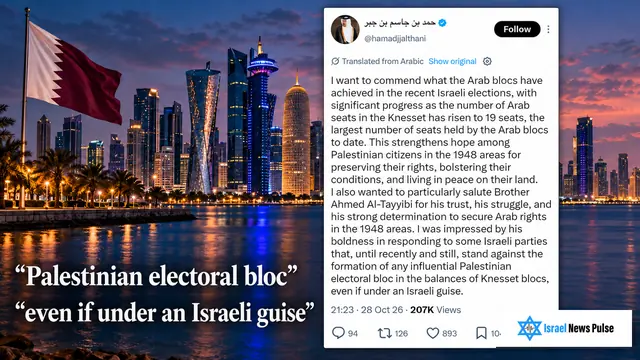
BBC Arabic Journalist Called Killers of Israeli Jews ‘Martyrs’, Reports Reveal
Jordanian BBC Arabic journalist Layla Bashar al-Kloub praised Palestinians implicated in the murder of Israeli Jews as “martyrs”, according to published investigations into her social media history. The same reporter later compiled a BBC Arabic account of journalists killed during the Gaza war that has come under scrutiny for including people reported to have links to Hamas and other terrorist organizations.
The allegations bring together two questions for the broadcaster: how it handled a journalist’s public expressions of support for attackers, and how it checked the identities of people presented to audiences as journalists killed in the war.
An October 10 investigation by The Telegraph, available through AOL, revisited posts spanning several years. Earlier reporting by the Jewish Chronicle and documentation from CAMERA, a pro-Israel media monitoring organization, had already raised concerns about al-Kloub’s statements.
The men she called ‘martyrs’
The Telegraph reported that al-Kloub used the term for Ahmad Jarrar in 2018 and Omar Abu Leila in 2019. Both cases involved attacks that killed Israeli Jews.
Jarrar, also identified as Ahmad Nassar Jarrar, was named by Israeli authorities as the leader of the cell responsible for the January 2018 shooting that killed Rabbi Raziel Shevach. Israeli forces killed Jarrar the following month. Contemporary reporting by JNS described the operation and his role in the cell.
In a post reproduced by the Jewish Chronicle, al-Kloub objected to Facebook removing material about Jarrar and called him a Palestinian martyr.
Abu Leila was identified as the attacker in the March 2019 stabbing and shooting near Ariel that killed an Israeli soldier and Rabbi Ahiad Ettinger. He was subsequently killed by Israeli security forces. Reporting at the time recorded the attack and the operation against him.
Years of hostile statements about Israel
The reported posts extended beyond those two attackers.
According to The Telegraph, al-Kloub told an Israeli social media user in 2014 that the land had been Palestine before the arrival of people she called terrorists. She also said Palestinians were prepared to die for it, while denying that the territory belonged to the Israeli user.
In 2016, she wrote:
“The Zionist entity does not recognize any international law or agreement; their entire [legal] proceedings are infringements of human rights treaties. They are the terrorists, not us.”
CAMERA’s documentation includes a screenshot of the post and places it in the context of the sentencing of Palestinian assailant Ahmed Manasrah. CAMERA reports that she joined the BBC in October 2020, meaning the 2014-2019 statements predated that employment.
The Telegraph also reported a 2017 post declaring the territory “from the river to the sea” to be “Arab, Arab, Arab”. The geographical reference encompasses Israel and the Palestinian territories.
Support for a presenter accused of Holocaust denial
Al-Kloub’s praise for Palestinian presenter Muna Hawwa came in May 2021, after she had joined the BBC.
Hawwa had presented a 2019 AJ+ Arabic video that questioned the established account of the Holocaust and alleged that Zionists benefited from it. Al Jazeera withdrew the video and suspended two journalists involved in its production, as The National reported at the time. Hawwa has rejected the accusation that she denied the Holocaust.
An archived May 20, 2021 post shows al-Kloub addressing Hawwa directly. She praised her journalism and portrayed her ability to compete with large institutions as a victory, ending with the encouragement: “May Allah strengthen you.”
The post documents support for Hawwa. It does not, by itself, establish that al-Kloub endorsed every claim in the earlier Holocaust video.
The Gaza list and the BBC’s response
An archived version of the BBC Arabic article confirms al-Kloub’s byline and its original publication date of October 28, 2023. The article profiled people killed during the war and cited the Committee to Protect Journalists.
In September 2026, the Jewish Chronicle reported on a Telegraph investigation that identified alleged links to Hamas or other terrorist groups among 53 of 180 people listed by BBC Arabic. Those figures describe that investigation’s findings; they are not an independent count by Israel News Pulse. Employment by an affiliated media outlet and participation in an armed group are also distinct claims requiring individual evidence.
The BBC told the Jewish Chronicle that its report had last been updated in August 2025 and that it was reviewing the names following a June 2026 CPJ update. In the October Telegraph report, the broadcaster also said it had urgently investigated the social media allegations, while declining to discuss individual staff matters. No specific disciplinary outcome was disclosed in that response.
An award despite the concerns
Al-Kloub nevertheless won Jordan’s 2025 Culture and Creativity category in the British Council’s Study UK Alumni Awards. SOAS publicized the award on April 16, 2025, describing recognition for her contribution to global media and digital storytelling. The British Council’s finalist profile highlighted her senior role in BBC Arabic’s Gaza and Lebanon war coverage.
The British Council told the Jewish Chronicle in May 2025 that an independent panel had reviewed concerns and found insufficient evidence to overturn the original decision.
That decision left the central editorial question unresolved in public: how did the BBC assess the reported praise for attackers when assigning and supervising coverage of Israeli victims and Palestinian fatalities? The broadcaster has described an investigation and a review of its reporting, but its quoted response did not explain the findings about al-Kloub herself.